
Technical Support & Resources
Visit our FAQ
Contact Us
Toll Free Phone (USA and Canada Only): (888) 526-5351
Direct Phone: (734) 975-3888
Product Categories
Product Type
Technical Information
- HEL-S-71p
- β-1 Metal-binding Globulin
- TFQTL1
- Serotransferrin
- Siderophillin
Shipping & Storage Information
Recommended Products
Certificates of Analysis & Batch Specific Data
Provide batch numbers separated by commas to download or request available product inserts, QC sheets, certificates of analysis, data packs, and GC-MS data.

Visit Our Cancer Resource Center
Find Tools & Resources to Study the Hallmarks of Cancer
- Cancer cell signaling & regulation
- Cancer metabolism
- Tumor microenvironment
Product Description
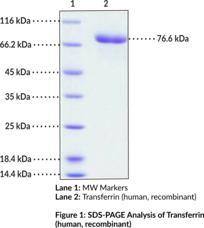
Transferrin is a glycoprotein that binds and transports ferric iron.1,2 It is a 679-amino acid bilobal protein composed of N- and C-terminal lobes, each housing a ferric iron binding site, connected by a seven-amino acid bridge.1 Transferrin is predominately synthesized in hepatocytes, but is also expressed in Sertoli, ependymal, oligodendroglial, and metastatic melanoma cell lines, and is secreted into the circulation.1,2 Iron-containing transferrin binds to the transferrin receptor (TfR1; Item No. 32031) on the surface of iron-requiring cells to form the transferrin/TfR complex, which undergoes clathrin-dependent endocytosis to facilitate intracellular iron release. The transferrin/TfR complex is then returned to the cell surface and apo-transferrin is released back into the circulation via dissociation or displacement by an iron-containing transferrin.1 Immunodepletion of transferrin inhibits serum-induced ferroptosis of Bax and Bak double knockout mouse embryonic fibroblasts (MEFs), indicating that transferrin is a regulator of ferroptosis.3 Exogenous administration of apo-transferrin to three-day-old rats increases expression of myelin constituents and enhances myelinogenesis in myelin-deficient rats.4 It also normalizes labile plasma iron concentrations and red blood cell survival, increases hemoglobin production, and decreases reticulocytosis and splenomegaly in the Hbbth1/th1 mouse model of β-thalassemia.5 Cayman’s Transferrin (human, recombinant) protein can be used for ELISA and cell-based assay applications. This protein consists of 690 amino acids, has a calculated molecular weight of 76.6 kDa, and a predicted N-terminus of Val20 after signal peptide cleavage.
WARNING This product is not for human or veterinary use.
References & Product Citations
1. Transferrin-
2. Transferrin: Structure, function and potential therapeutic actions. Drug Discov. Today 10(4), 267-273 (2005).
3. Glutaminolysis and transferrin regulate ferroptosis. Mol. Cell. 59(2), 298-308 (2015).
4. Transferrin enhances microglial phagocytic capacity. Mol. Neurobiol. 56(9), 6324-6340 (2019).
5. Transferrin therapy ameliorates disease in β-
Contact Info
Cayman Chemical1180 East Ellsworth RoadAnn Arbor, Michigan 48108 USAToll Free: (800) 364-9897(USA and Canada only)Fax: (734) 971-3640


