
Technical Support & Resources
Visit our FAQ
Contact Us
Toll Free Phone (USA and Canada Only): (888) 526-5351
Direct Phone: (734) 975-3888
Product Categories
Product Type
Application
Transferrin Receptor Protein 1/CD71 Extracellular Domain (human, recombinant)
Item No. 32031
Technical Information
- IMD46
- P90
- TfR1
- Transferrin Receptor Protein 1
Shipping & Storage Information
Recommended Products
Certificates of Analysis & Batch Specific Data
Provide batch numbers separated by commas to download or request available product inserts, QC sheets, certificates of analysis, data packs, and GC-MS data.

Visit Our Cancer Resource Center
Find Tools & Resources to Study the Hallmarks of Cancer
- Cancer cell signaling & regulation
- Cancer metabolism
- Tumor microenvironment
Product Description
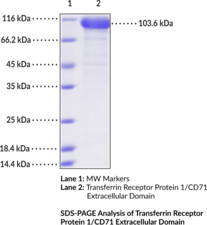
Transferrin receptor protein 1 (TfR1), also known as CD71, is a homodimeric transmembrane receptor for transferrin (Item No. 32030) that facilitates iron delivery into cells and is encoded by TFRC in human.1 It is composed of two TfR1 monomers, each composed of a 67-amino acid cytoplasmic tail with an internalization motif, a membrane spanning portion, a stalk region that covalently links the monomers, and an extracellular ectodomain. The ectodomain binds transferrin and is composed of an apical domain, a protease-like domain, and a helical domain that drives TfR1 dimerization.1,2 TfR1 is ubiquitously expressed, except on mature red blood cells and certain terminally differentiated cells, with the highest expression on immature erythroid cells and in the placenta, and is involved in erythropoiesis, lymphocyte development, and hematopoietic expansion in the bone marrow.3,4 TfR1/transferrin-mediated iron transport contributes to the intracellular iron pool required for ferroptosis and anti-TfR1 antibodies have been used in combination with anti-malondialdehyde antibodies to identify ferroptotic cells in vitro and human cancer tissue in a mouse xenograft model.5 A soluble form of TFR1 is present in serum and increased levels are associated with autoimmune hemolytic anemia, polycythemia vera, and iron deficiency anemia, while decreased levels are associated with chronic renal failure and aplastic anemia.6 TFRC is overexpressed in various breast cancer tumors and gliomas and positively correlated with poor prognosis.7 Cayman's Transferrin Receptor Protein 1/CD71 Extracellular Domain (human, recombinant) protein is a disulfide-linked homodimer. The reduced monomer, comprised of TfR1 (amino acids 89-760) fused to human IgG1 Fc at its N-terminus, consists of 932 amino acids and has a calculated molecular weight of 103.6 kDa.
WARNING This product is not for human or veterinary use.
References & Product Citations
1. Transferrin-
2. The transferrin receptor: The cellular iron gate. Metallomics 9(10), 1367-1375 (2017).
3. The transferrin receptor: Role in health and disease. Int. J. Biochem. Cell Biol. 31(10), 1111-1137 (1999).
4. Transferrin receptor 1-
5. Transferrin receptor is a specific ferroptosis marker. Cell Rep. 30(10), 3411-3423 (2020).
6. Biological and clinical aspects of soluble transferrin receptor. Crit. Rev. Clin. Lab. Sci. 47(5-6), 213-228 (2010).
7. Transferrin receptor 1 in cancer: A new sight for cancer therapy. Am. J. Cancer Res. 8(6), 916-931 (2018).
Contact Info
Cayman Chemical1180 East Ellsworth RoadAnn Arbor, Michigan 48108 USAToll Free: (800) 364-9897(USA and Canada only)Fax: (734) 971-3640


