
Technical Support & Resources
Visit our FAQ
Contact Us
Toll Free Phone (USA and Canada Only): (888) 526-5351
Direct Phone: (734) 975-3888
Product Categories
Product Type
Application
Technical Information
- Basic Fibroblast Growth Factor
- BFGF
- FGFB
- Fibroblast Growth Factor 2
- HBFG2
- Heparin-binding Growth Factor 2
Shipping & Storage Information
Recommended Products
Certificates of Analysis & Batch Specific Data
Provide batch numbers separated by commas to download or request available product inserts, QC sheets, certificates of analysis, data packs, and GC-MS data.
Kinase Resource Center
Discover Products & Resources for Kinase Research
- Kinase inhibitors, screening libraries, assay kits, & more
- Tools to study kinase signaling pathways:
- Growth factor signaling
- PI3K/Akt/mTOR
- MAPKs (ERK, p38, & JNK)
- JAK/STAT signaling
- Articles, resources, & advice
Product Description
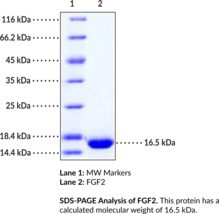
Fibroblast growth factor 2 (FGF2), also known as basic FGF (BFGF), is a signaling polypeptide and member of the FGF family that has roles in cell growth and differentiation.1,2 Alternative translation produces multiple isoforms of FGF2: one 18 kDa low molecular weight isoform that is translated from a conventional AUG start codon and represents the core sequence common to all FGF2 isoforms, and several high molecular weight isoforms containing amino terminal extensions of the 18 kDa isoform that use CUG codons as alternative translational start sites.1 The 18 kDa isoform of FGF2 is found in the nucleus and cytoplasm and can be secreted by target cells. It forms a ternary complex with heparan sulfate proteoglycans and an FGF receptor (FGFR) at the cell surface resulting in activation of various signaling pathways, including Ras, Raf, MAPK, and ERK. High molecular weight isoforms are localized to the nucleus and induce signaling independent of FGFRs. FGF2 expression is spatially and temporally regulated during development and is concurrent with neurogenesis.3 Exogenous administration of FGF2 enhances neurogenesis in the subventricular zone and subgranular zone in an adult rat model of traumatic brain injury. It also reduces infarct size and increases myocardial capillary density in a canine model of myocardial infarction induced by permanent coronary artery occlusion.2 Lung and kidney expression of FGF2 is increased in a common marmoset model of Middle East respiratory syndrome coronavirus (MERS-CoV) infection.4 Cayman’s FGF2 (human, recombinant) protein can be used for cell-based assay applications. The protein consists of 147 amino acids and has a calculated molecular weight of 16.5 kDa.
WARNING This product is not for human or veterinary use.
References & Product Citations
1. Molecular and clinical significance of fibroblast growth factor 2 (FGF2 /bFGF) in malignancies of solid and hematological cancers for personalized therapies. Oncotarget 7(28), 44735-44762 (2016).
2. Biological functions of the low and high molecular weight protein isoforms of fibroblast growth factor-
3. Fibroblast growth factor-
4. MERS coronavirus induces apoptosis in kidney and lung by upregulating Smad7 and FGF2. Nat. Microbiol. 1(3), 16004 (2016).
Contact Info
Cayman Chemical1180 East Ellsworth RoadAnn Arbor, Michigan 48108 USAToll Free: (800) 364-9897(USA and Canada only)Fax: (734) 971-3640


