
Technical Support & Resources
Visit our FAQ
Contact Us
Toll Free Phone (USA and Canada Only): (888) 526-5351
Direct Phone: (734) 975-3888
Technical Information
- Fibroblast Growth Factor 10
- Keratinocyte Growth Factor 2
- KGF2
Shipping & Storage Information
Recommended Products
Certificates of Analysis & Batch Specific Data
Provide batch numbers separated by commas to download or request available product inserts, QC sheets, certificates of analysis, data packs, and GC-MS data.
Kinase Resource Center
Discover Products & Resources for Kinase Research
- Kinase inhibitors, screening libraries, assay kits, & more
- Tools to study kinase signaling pathways:
- Growth factor signaling
- PI3K/Akt/mTOR
- MAPKs (ERK, p38, & JNK)
- JAK/STAT signaling
- Articles, resources, & advice
Product Description
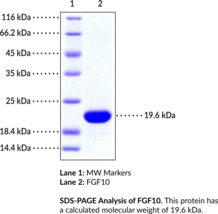
Fibroblast growth factor 10 (FGF10) is a member of the paracrine subfamily of FGFs that mediates mesenchymal to epithelial signaling.1 It is a secreted protein that contains a typical N-terminal signal sequence and is expressed exclusively in the mesenchyme. FGF10 binds to FGF receptor 2b (FGFR2B) in the epithelium, either alone or in a ternary complex with heparan sulfate, to induce intracellular signaling. FGF10 is essential to organ development and Fgf10 knockout mice exhibit limb, lung, thyroid, anterior pituitary, and salivary gland agenesis, as well as tooth, hair follicle, inner ear, thymic, pancreatic, and glandular stomach dysgenesis. Inherited heterozygous loss-of-function mutations in FGF10 cause aplasia of lacrimal and salivary glands (ALSG), Lacrimo-auriculo-dento-digital (LADD) syndrome, and chronic obstructive pulmonary disease (COPD) in humans. SNPs in FGF10 are highly associated with cleft lip and/or palate and extreme myopia, or near-sightedness, in humans.2 FGF10 is overexpressed in some human breast carcinomas and FGF10 induces migration and metastasis of prostate cancer cells in vitro.1,3 Cayman's FGF10 (human, recombinant) protein consists of 172 amino acids and has a calculated molecular weight of 19.6 kDa.
WARNING This product is not for human or veterinary use.
References & Product Citations
1. FGF10: A multifunctional mesenchymal–epithelial signaling growth factor in development, health, and disease. Cytokine Growth Factor Rev. 28, 63-69 (2016).
2. Bones, glands, ears and more: The multiple roles of FGF10 in craniofacial development. Front. Genet. 9, 542 (2018).
3. Regulation of FGF10 signaling in development and disease. Front. Genet. 9, 500 (2018).
Contact Info
Cayman Chemical1180 East Ellsworth RoadAnn Arbor, Michigan 48108 USAToll Free: (800) 364-9897(USA and Canada only)Fax: (734) 971-3640


