
Technical Support & Resources
Visit our FAQ
Contact Us
Toll Free Phone (USA and Canada Only): (888) 526-5351
Direct Phone: (734) 975-3888
Product Categories
Product Type
Technical Information
- 30 kDa Adipocyte Complement-related Protein
- Adipose Specific Collagen-like Factor
- Adipocyte, C1q and Collagen Domain-containing Protein
- Adipocyte Complement-related 30 kDa Protein
Shipping & Storage Information
Recommended Products
Certificates of Analysis & Batch Specific Data
Provide batch numbers separated by commas to download or request available product inserts, QC sheets, certificates of analysis, data packs, and GC-MS data.

Explore Obesity & Metabolic Disease Resources
Discover high-quality research tools to investigate GLP-1 mechanisms and next-generation metabolic targets.
OBESITY RESEARCH SOLUTIONSProduct Description
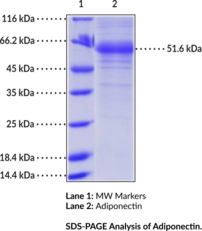
Adiponectin is a pleiotropic adipokine and homolog of the complement 1q (C1q) family encoded by ADIPOQ in humans.1 It is composed of an N-terminal signal sequence, a hypervariable region, a collagenous domain, and a C-terminal C1q-like globular domain. It is produced in adipocytes, where the approximately 27 kDa monomeric protein is post-translationally modified to induce formation of trimer, hexamer, and high molecular weight (HMW) adiponectin containing 12 to 18 monomers that circulate in serum. These adiponectin multimers have distinct biological activities and do not interconvert once present in the circulation. Peroxisome proliferator-activated receptor γ (PPARγ) is the major positive regulator of ADIPOQ expression but expression is also regulated by forkhead box protein O1 (FOXO1) and sterol regulatory element binding protein 1c (SREBP1c). Plasma levels of adiponectin are decreased in ob/ob mice and mice with diet-induced obesity that have insulin resistance, and exogenous administration of adiponectin improves insulin sensitivity in these mice by increasing β-oxidation in the skeletal muscle and reducing hepatic and musculoskeletal triglyceride content. Chronic administration of adiponectin reduces hyperglycemia, hyperinsulinemia, and body weight in a mouse model of high-fat diet-induced obesity. High plasma levels of adiponectin are associated with coronary heart disease in diabetic women.2 Plasma levels of adiponectin are positively correlated with disease severity in patients with chronic kidney disease.3 Cayman's Adiponectin (human, recombinant) protein is a disulfide-linked homodimer. The reduced monomer, comprised of adiponectin (amino acids 19-244) fused to human IgG1 Fc at its C-terminus, consists of 467 amino acids, has a calculated molecular weight of 51.6 kDa, and a predicted N-terminus of Glu19 after signal peptide cleavage.
WARNING This product is not for human or veterinary use.
References & Product Citations
1. Adiponectin regulation and function. Compr. Physiol. 8(3), 1031-1063 (2018).
2. Adiponectin, lipids and atherosclerosis. Curr. Opin. Lipidol. 28(4), 347-354 (2017).
3. Adiponectin and end-
Contact Info
Cayman Chemical1180 East Ellsworth RoadAnn Arbor, Michigan 48108 USAToll Free: (800) 364-9897(USA and Canada only)Fax: (734) 971-3640


