
Technical Support & Resources
Visit our FAQ
Contact Us
Toll Free Phone (USA and Canada Only): (888) 526-5351
Direct Phone: (734) 975-3888
Product Categories
Product Type
Application

Technical Information
- β-Nerve Growth Factor
- NGFβ
Shipping & Storage Information
Recommended Products
Certificates of Analysis & Batch Specific Data
Provide batch numbers separated by commas to download or request available product inserts, QC sheets, certificates of analysis, data packs, and GC-MS data.
Kinase Resource Center
Discover Products & Resources for Kinase Research
- Kinase inhibitors, screening libraries, assay kits, & more
- Tools to study kinase signaling pathways:
- Growth factor signaling
- PI3K/Akt/mTOR
- MAPKs (ERK, p38, & JNK)
- JAK/STAT signaling
- Articles, resources, & advice
Product Description
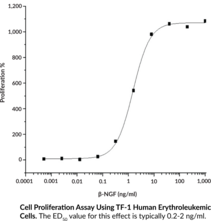
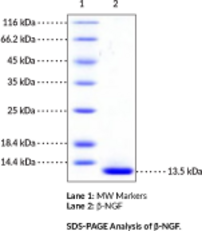
β-Nerve growth factor (β-NGF) is a neurotrophin that is involved in the regulation of growth, proliferation, and survival of sympathetic and sensory neurons.1 NGF encodes pro-NGF that is composed of an N-terminal signal peptide and α-, γ-, and β-NGF domains. β-NGF, also known as mature or functional NGF, is produced after degradation of the signaling peptide and proteolytic cleavage of pro-NGF at Ser122.2,3 β-NGF homodimerizes and induces neurotropic signaling through tropomyosin-related kinase A (TrkA) and the p75 neurotrophin receptor (p75NTR).3 β-NGF is produced by neurons in the cortex, pituitary gland, hippocampus, basal ganglia, thalamus, spinal cord, and retina, as well as in non-neuronal target cells of sympathetic and sensory neurons such as keratinocytes, vascular smooth muscle cells, exocrine salivary glands, and endocrine tissues.3,4 Exogenous administration of β-NGF improves neurological deficits in murine models of traumatic brain injury (TBI), and β-NGF levels in the cerebrospinal fluid of TBI patients are positively correlated with neurological outcomes.3 Exogenous administration of β-NGF also accelerates the rate of skin excision wound healing in rats. Cayman’s β-NGF (human, recombinant) protein can be used for cell-based assay applications. This protein consists of 118 amino acids and has a calculated molecular mass of 13.2 kDa.
WARNING This product is not for human or veterinary use.
References & Product Citations
1. NGF, BDNF, NT3, and NT4. Neurotrophic Factors. Handbook of Experimental Pharmacology 220, 3-15 (2014).
2. Human β-
3. Nerve growth factor: Early studies and recent clinical trials. Curr. Neuropharmacol. 16(10), 1455-1465 (2018).
4. Nerve growth factor signaling, neuroprotection, and neural repair. Annu. Rev. Neurosci. 24, 1217-1281 (2001).
Contact Info
Cayman Chemical1180 East Ellsworth RoadAnn Arbor, Michigan 48108 USAToll Free: (800) 364-9897(USA and Canada only)Fax: (734) 971-3640


