
Technical Support & Resources
Visit our FAQ
Contact Us
Toll Free Phone (USA and Canada Only): (888) 526-5351
Direct Phone: (734) 975-3888
Technical Information
- Cell Proliferation-Inducing Gene 35 Protein
- Early Population Doubling Level cDNA-1
- EPC-1
- Pigment Epithelium-Derived Factor
- Serpin F1
Shipping & Storage Information
Recommended Products
Certificates of Analysis & Batch Specific Data
Provide batch numbers separated by commas to download or request available product inserts, QC sheets, certificates of analysis, data packs, and GC-MS data.
Kinase Resource Center
Discover Products & Resources for Kinase Research
- Kinase inhibitors, screening libraries, assay kits, & more
- Tools to study kinase signaling pathways:
- Growth factor signaling
- PI3K/Akt/mTOR
- MAPKs (ERK, p38, & JNK)
- JAK/STAT signaling
- Articles, resources, & advice
Product Description
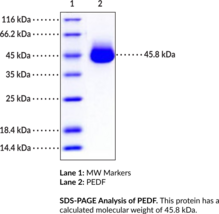
Pigment epithelium-derived factor (PEDF) is a secreted glycoprotein encoded by the SERPINF1 gene.1 It is a non-inhibitory member of the serine-protease inhibitor (SERPIN) superfamily that has anti-angiogenic and neurotrophic activities. PEDF is a 418-amino acid protein comprised of an N-terminal region important for its neurotrophic activity, three β-sheets and ten α-helices that make up an α/β core serpin domain, and a C-terminal region containing a glycosylation site.1,2 It has an asymmetrical charge distribution with the basic region involved in glycosaminoglycan binding and the acidic region binding to collagen I.2 PEDF is ubiquitously expressed and localized to the extracellular matrix but can also be found in the cytoplasm and nucleus of retinal pigment epithelial cells and certain cancer cell lines.1,3 It contains biologically active peptides, including a 34-amino acid peptide (amino acids 44-77), which contains a laminin receptor binding site and has anti-angiogenic, bone mineralization, and apoptotic activities, and a 44-amino acid peptide (amino acids 78-121), which contains a PNPLA2 binding site and promotes neuronal differentiation and inhibits vascular permeability.1,4,5 PEDF also interacts with collagen I for its anti-angiogenic activity, as well as with sulfated (heparin) and non-sulfated (hyaluronan) glycosaminoglycans, which are important for PNPLA2 receptor binding and activation of caspases, respectively.1,2 Its expression is reduced in a variety of cancer cell lines and solid tumors, and the reduction is associated with metastasis and poor prognosis.2 Mutations in SERPINF1 are responsible for the hereditary bone dysplasia disorder osteogenesis imperfecta type VI, which is characterized by bone fragility, deformity, and growth deficiency.6 Cayman’s PEDF (human, recombinant) protein consists of 410 amino acids, has a calculated molecular weight of 45.8 kDa, and a predicted N-terminus of Gln20 after signal peptide cleavage.
WARNING This product is not for human or veterinary use.
References & Product Citations
1. Structure-
2. Characterization of PEDF: A multi-
3. PEDF and the serpins: Phylogeny, sequence conservation, and functional domains. J. Struct. Biol. 151(2), 130-150 (2005).
4. Pigment epithelium–derived factor restoration increases bone mass and improves bone plasticity in a model of osteogenesis imperfecta type VI via Wnt3a blockade. The FASEB Journal 30(8), 2837-2848 (2016).
5. Laminin receptor involvement in the anti-
6. New genes in bone development: What’s new in osteogenesis imperfecta. J. Clin. Endocrinol. Metab. 98(8), 3095-3103 (2013).
Contact Info
Cayman Chemical1180 East Ellsworth RoadAnn Arbor, Michigan 48108 USAToll Free: (800) 364-9897(USA and Canada only)Fax: (734) 971-3640


