
Technical Support & Resources
Visit our FAQ
Contact Us
Toll Free Phone (USA and Canada Only): (888) 526-5351
Direct Phone: (734) 975-3888
Technical Information
- Fibroblast Growth Factor 19
Shipping & Storage Information
Recommended Products
Certificates of Analysis & Batch Specific Data
Provide batch numbers separated by commas to download or request available product inserts, QC sheets, certificates of analysis, data packs, and GC-MS data.

Explore Obesity & Metabolic Disease Resources
Discover high-quality research tools to investigate GLP-1 mechanisms and next-generation metabolic targets.
OBESITY RESEARCH SOLUTIONSProduct Description
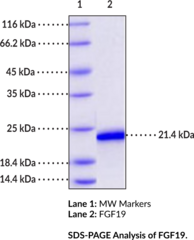
Fibroblast growth factor 19 (FGF19) is a hepatokine and member of the endocrine subfamily of FGFs with roles in bile acid synthesis, gallbladder filling, glycogen synthesis, and gluconeogenesis.1 Mature FGF19 is a secreted 190-amino acid peptide composed of an N-terminal FGFR binding site, a conserved 120-amino acid core, and a C-terminal sequence that facilitates binding to the klotho beta (KLB) co-receptors.1,2 It is derived from a 216-amino acid protein that contains an additional 26-amino acid signaling peptide, which drives constitutive secretion. FGF19 is primarily expressed in the fetal brain and adult gallbladder but is also expressed in various other tissues. Unlike other FGFs, FGF19 has low affinity for heparin and binds to KLB to induce intracellular signaling through FGFR4.2 Knockout of Fgf15, the murine ortholog of FGF19, reduces hepatic glycogen levels and induces glucose intolerance in mice, effects that can be reversed by exogenous administration of FGF19.3 Fgf15-/- mice also exhibit dysregulated bile acid metabolism. Intracerebroventricular infusion of FGF19 potentiates peripheral insulin signaling in a mouse model of insulin resistance. Serum levels of FGF19 are increased in patients with extrahepatic cholestasis and are reduced in patients with inflammatory bowel disease, primary bile acid malabsorption, type-2 diabetes, and non-alcoholic fatty liver disease (NAFLD). Upregulated FGF19 expression is associated with tumor progression and poor prognosis in patients with hepatocellular carcinoma. Cayman’s FGF19 (human, recombinant) consists of 191 amino acids and has a calculated molecular weight of 21.4 kDa.
WARNING This product is not for human or veterinary use.
References & Product Citations
1. FGF19-
2. The crystal structure of fibroblast growth factor (FGF) 19 reveals novel features of the FGF family and offers a structural basis for its unusual receptor affinity. Biochemistry 43(3), 629-640 (2004).
3. Therapeutic potential of the endocrine fibroblast growth factors FGF19, FGF21 and FGF23. Nat. Rev. Drug Discov. 15(1), 51-69 (2016).
Contact Info
Cayman Chemical1180 East Ellsworth RoadAnn Arbor, Michigan 48108 USAToll Free: (800) 364-9897(USA and Canada only)Fax: (734) 971-3640


