
Technical Support & Resources
Visit our FAQ
Contact Us
Toll Free Phone (USA and Canada Only): (888) 526-5351
Direct Phone: (734) 975-3888
Technical Information
- 4-1BBL
- CD137L
- CD137 Ligand
- TNFSF9
Shipping & Storage Information
Recommended Products
Certificates of Analysis & Batch Specific Data
Provide batch numbers separated by commas to download or request available product inserts, QC sheets, certificates of analysis, data packs, and GC-MS data.
Kinase Resource Center
Discover Products & Resources for Kinase Research
- Kinase inhibitors, screening libraries, assay kits, & more
- Tools to study kinase signaling pathways:
- Growth factor signaling
- PI3K/Akt/mTOR
- MAPKs (ERK, p38, & JNK)
- JAK/STAT signaling
- Articles, resources, & advice
Product Description
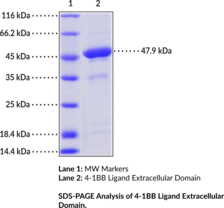
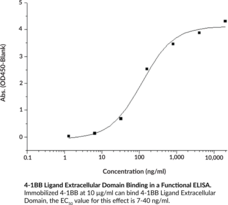
TNF ligand superfamily member 9 (4-1BB ligand) is a type II transmembrane glycoprotein and a member of the TNF superfamily.1,2 It is composed of an N-terminal cytoplasmic region, a transmembrane domain, and a C-terminal extracellular tail region that contains a TNF homology domain.2,3 4-1BB ligand production is induced in antigen-presenting cells (APCs), such as dendritic cells, B cells, and macrophages, by CD40 and toll-like receptor (TLR) activation.2 It forms homotrimers and binds to its receptor, 4-1BB, on antigen-primed T cells, which induces NF-κB and MAPK signaling through TNF receptor-associated factors (TRAFs) and, when the T cell is co-stimulated by other factors, induces PI3K-Akt signaling.1,2 This action promotes the proliferation of T cells, production of cytokines, and cell survival.2 Soluble forms of 4-1BB ligand, consisting of only the extracellular domain, also form trimers that bind to its receptor but do not induce signaling.4 Mice deficient for 4-1BB ligand, Tnfsf9, have impairments in the formation of CD8+ T cell memory cells and in clearing pathogens.2,5 Tnfsf9 knockout mice also develop B cell lymphomas before 12 months of age.6 4-1BB ligand antibodies induce T regulatory cell expansion and prevent allogeneic graft rejection of pancreatic islets in mice.7 Intratumoral adenovirus-mediated gene transfer of Tnfsf9 induces tumor regression in a mouse syngeneic model of breast cancer.6 The protein levels of 4-1BB ligand are elevated in more than 40% of patients with acute myeloid leukemia (AML) or non-Hodgkin’s lymphoma but the expression of TNFSF9 is either elevated or reduced in cancer patients depending on the type of cancer. Cayman’s 4-1BB Ligand Extracellular Domain (human, recombinant) protein can be used for ELISA and binding assay applications. This protein is a disulfide-linked homodimer. The reduced monomer, comprised of 4-1BB ligand (amino acids 71-254) fused to human IgG1 Fc at the N-terminus, consists of 444 amino acids and has a calculated molecular weight of 47.9 kDa.
WARNING This product is not for human or veterinary use.
References & Product Citations
1. A novel form of 4-
2. The TNF–TNFR family of co-
3. Crystal structures of the human 4-
4. Trimer stabilization, oligomerization, and antibody-
5. Immune regulation by 4-
6. Immunotherapy of cancer with 4-
7. Ex vivo expansion of CD4+CD25+FoxP3+ T regulatory cells based on synergy between IL-
Contact Info
Cayman Chemical1180 East Ellsworth RoadAnn Arbor, Michigan 48108 USAToll Free: (800) 364-9897(USA and Canada only)Fax: (734) 971-3640


