
Technical Support & Resources
Visit our FAQ
Contact Us
Toll Free Phone (USA and Canada Only): (888) 526-5351
Direct Phone: (734) 975-3888
Nectin-2 Extracellular Domain (mouse, recombinant)
Item No. 32074
Technical Information
- CD112
- Herpesvirus Entry Mediator B
- HveB
- Nectin Cell Adhesion Molecule 2
- Poliovirus Receptor-related Protein 2
- PRR2
Shipping & Storage Information
Recommended Products
Certificates of Analysis & Batch Specific Data
Provide batch numbers separated by commas to download or request available product inserts, QC sheets, certificates of analysis, data packs, and GC-MS data.

Visit Our Cancer Resource Center
Find Tools & Resources to Study the Hallmarks of Cancer
- Cancer cell signaling & regulation
- Cancer metabolism
- Tumor microenvironment
Product Description
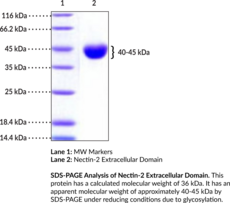
Nectin-2, also known as CD112, is a member of the nectin family of adhesion molecules that mediates the formation of adherens junctions and regulates immune cell activation.1 It contains an N-terminal extracellular domain with three immunoglobulin-like (Ig-like) loops, C1-like and C2 domains that mediate dimerization, a transmembrane segment, and a C-terminal cytoplasmic tail that binds to the actin filament-binding protein afadin.1,2 Nectin-2 is expressed by a variety of cell types, including epithelial cells, neurons, fibroblasts, Sertoli cells, and cancer cells, and is upregulated by TGF-β1 (Item No. 30606) or IFN-β stimulation.2,3,1 It localizes to the cell surface where it forms cis-homodimers that associate by trans-interactions with cis-homodimers of other nectins and nectin-like molecules (Necls) expressed on adjacent cells, resulting in cell-cell adhesion.4,1 Nectin-2 binds the co-stimulatory receptor CD226/DNAM-1, which is widely expressed by most immune cells, including T cells, B cells, natural killer (NK) cells, and monocytes, and the inhibitory receptors TIGIT and CD96, which are expressed by NK cells and T cells, thus regulating both the activation or inhibition of immune cells in a receptor-specific manner.1 It is also the receptor for herpesvirus entry into cells. Sperm isolated from Nectin2-/- mice have decreased motility and maturation and fail to fuse with oocytes, resulting in male-specific infertility.5 Neutralization of nectin-2 with a monoclonal antibody decreases tumor growth and reduces metastasis in OV-90 or MDA-MB-231 mouse xenograft models, respectively.2 Cayman's Nectin-2 Extracellular Domain (mouse, recombinant) protein can be used for binding assay applications. This protein consists of 331 amino acids, has a calculated molecular weight of 36 kDa, and a predicted N-terminus of Gln32 after signal peptide cleavage. By SDS-PAGE, under reducing conditions, the apparent molecular mass of the protein is 40 to 45 kDa due to glycosylation.
WARNING This product is not for human or veterinary use.
References & Product Citations
1. Nectins and nectin-
2. Nectin-
3. Nectins and nectin-
4. Targeting PVR (CD155) and its receptors in anti-
5. Cross-
Contact Info
Cayman Chemical1180 East Ellsworth RoadAnn Arbor, Michigan 48108 USAToll Free: (800) 364-9897(USA and Canada only)Fax: (734) 971-3640


