
Technical Support & Resources
Visit our FAQ
Contact Us
Toll Free Phone (USA and Canada Only): (888) 526-5351
Direct Phone: (734) 975-3888
Product Categories
Product Type
Application
Technical Information
- T Cell Immunoreceptor with Ig and ITIM Domains
- V-set and Immunoglobulin Domain-Containing Protein 9
- V-set and Transmembrane Domain-Containing Protein 3
- VSig9
- Vstm3
- Washington University Cell Adhesion Molecule
- WUCAM
Shipping & Storage Information
Recommended Products
Certificates of Analysis & Batch Specific Data
Provide batch numbers separated by commas to download or request available product inserts, QC sheets, certificates of analysis, data packs, and GC-MS data.

Visit Our Cancer Resource Center
Find Tools & Resources to Study the Hallmarks of Cancer
- Cancer cell signaling & regulation
- Cancer metabolism
- Tumor microenvironment
Product Description
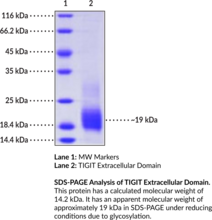
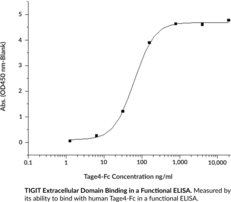
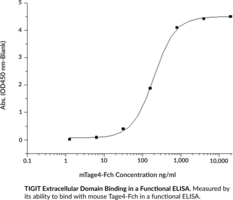
T cell immunoreceptor with Ig and ITIM domains (TIGIT) is a type I transmembrane immune receptor.1 It is composed of an N-terminal extracellular immunoglobulin variable (IgV) domain, a transmembrane domain, and a C-terminal cytoplasmic tail that contains an immunoglobulin tail tyrosine-like (ITT-like) phosphorylation motif and an immunoreceptor tyrosine-based inhibition motif (ITIM).2 The ITT-like and ITIM motifs are important for the signaling and inhibitory functions of TIGIT.1 It is expressed primarily on natural killer (NK) cells but also expressed on activated, memory, and follicular T helper cells, as well as certain regulatory T cells and exhausted T cells. TIGIT is a co-inhibitory molecule that acts in opposition to the co-stimulatory receptor CD226 (Item Nos. 32071 | 32072), preventing its interaction with their shared ligands, CD155/Tage4 and CD112/nectin-2, on antigen-presenting cells (APCs), infected cells, and tumor cells. TIGIT on NK cells inhibits NK cell-mediated APC cell killing and lysis, as well as APC-induced cytokine release that, in turn, inhibits IFN-γ secretion from NK cells.3 On T cells, TIGIT inhibits T cell cytokine production, proliferation, and T cell receptor signaling.1 It also associates with the adapter proteins Grb2 and β-arrestin 2 to recruit SHIP1 for inhibition of NK or T cell activation. In addition to its cell extrinsic activities, TIGIT has cell intrinsic activity, binding directly to CD226 to disrupt its function. Anti-TIGIT antibodies delay the growth of tumors, protect against metastasis, and decrease tumor burden in mouse models of cancer with an increased anticancer effect when used in combination with PD-1 inhibitors.4 TIGIT-/- mice have reduced tumor growth and increased survival compared to wild-type mice. The expression of TIGIT on immune cells in melanoma and gastric cancer patients is associated with metastasis and shorter overall survival. Cayman's TIGIT Extracellular Domain (human, recombinant) protein can be used for binding assay and ELISA applications. This protein consists of 128 amino acids, has a calculated molecular weight of 14.2 kDa, and a predicted N-terminus of Met22 after signal peptide cleavage. By SDS-PAGE, the apparent molecular mass of the protein is approximately 19 kDa due to glycosylation.
WARNING This product is not for human or veterinary use.
References & Product Citations
1. Tim-
2. Recruitment of Grb2 and SHIP1 by the ITT-
3. Balancing natural killer cell activation through paired receptors. Nat. Rev. Immunol. 15(4), 243-254 (2015).
4. TIGIT as an emerging immune checkpoint. Clin. Exp. Immunol. 200(2), 108-119 (2020).
Contact Info
Cayman Chemical1180 East Ellsworth RoadAnn Arbor, Michigan 48108 USAToll Free: (800) 364-9897(USA and Canada only)Fax: (734) 971-3640


