
Technical Support & Resources
Visit our FAQ
Contact Us
Toll Free Phone (USA and Canada Only): (888) 526-5351
Direct Phone: (734) 975-3888
Product Categories
Enteropeptidase (bovine, recombinant)
Item No. 32087
Technical Information
- Enterokinase
- Serine Protease 7
- Transmembrane Protease Serine 15
Shipping & Storage Information
Recommended Products
Certificates of Analysis & Batch Specific Data
Provide batch numbers separated by commas to download or request available product inserts, QC sheets, certificates of analysis, data packs, and GC-MS data.

Explore Obesity & Metabolic Disease Resources
Discover high-quality research tools to investigate GLP-1 mechanisms and next-generation metabolic targets.
OBESITY RESEARCH SOLUTIONSProduct Description
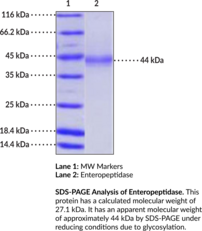
Enteropeptidase is a membrane-bound serine protease that converts the inactive enzyme trypsinogen to the active form trypsin, a protease that catalyzes the digestion of proteins in the gut.1 It is composed of an N-terminal domain with a transmembrane segment that anchors enteropeptidase to the cell membrane and an extracellular C-terminal protease domain that contains the activation cleavage site for enteropeptidase activity and a catalytic aspartic acid-histidine-serine triad.1,2 It is synthesized in the endoplasmic reticulum as a zymogen and transported to the brush border membrane of duodenal and jejunal enterocytes. Enteropeptidase activation occurs in a calcium- and pH-dependent manner and, upon activation, cleaves the Asp-Asp-Asp-Asp-Lys activation peptide on trypsinogen to produce trypsin.1,3 Pharmacological inhibition of enteropeptidase activity decreases food intake, body weight gain, and liver triglyceride and total cholesterol levels in diet-induced obese mice and diabetic obese ob/ob mice.4 Cayman's Enteropeptidase (bovine, recombinant) protein consists of 241 amino acids and has a calculated molecular weight of 27.1 kDa. By SDS-PAGE, under reducing conditions, the molecular weight of the protein is approximately 44 kDa due to glycosylation.
WARNING This product is not for human or veterinary use.
References & Product Citations
1. Enteropeptidase, a type II transmembrane serine protease. Front. Biosci. (Elite Ed.) 1, 242-249 (2009).
2. Membrane-
3. Enteropeptidase. Handbook of Proteolytic Enzymes 3, 2648-2653 (2013).
4. SCO-
Contact Info
Cayman Chemical1180 East Ellsworth RoadAnn Arbor, Michigan 48108 USAToll Free: (800) 364-9897(USA and Canada only)Fax: (734) 971-3640


