
Technical Support & Resources
Visit our FAQ
Contact Us
Toll Free Phone (USA and Canada Only): (888) 526-5351
Direct Phone: (734) 975-3888
Product Categories
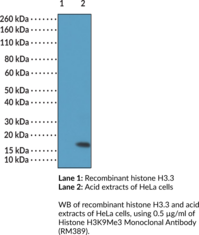
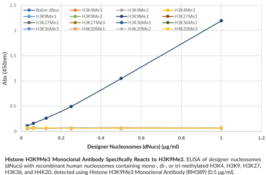
Technical Information
- Trimethylated Histone H3 Lysine 9
Shipping & Storage Information
Recommended Products
Certificates of Analysis & Batch Specific Data
Provide batch numbers separated by commas to download or request available product inserts, QC sheets, certificates of analysis, data packs, and GC-MS data.

Visit Our Cancer Resource Center
Find Tools & Resources to Study the Hallmarks of Cancer
- Cancer cell signaling & regulation
- Cancer metabolism
- Tumor microenvironment
Product Description
Histone H3 is a nuclear protein and a component of the nucleosome core, a basic unit of chromatin, that is essential for organizing genomic DNA in eukaryotic nuclei.1 It is a globular protein that contains an unstructured N-terminal tail that extends outside of the nucleosome core and is subject to various post-translational modifications (PTMs), including methylation, phosphorylation, acetylation, and citrullination.1,2 Trimethylation of histone H3 at lysine 9 (H3K9Me3) occludes DNA binding by transcription factors and is associated with gene repression.3 H3K9Me3 is also a binding target of the heterochromatin protein 1 (HP1) family proteins CBX1, CBX3, and CBX5.4 It is recognized by the plant homeodomain (PHD) fingers of chromodomain helicase DNA binding protein 4 (CHD4), a member of the NuRD deacetylase complex that is upregulated in a variety of cancers and implicated in the DNA damage response.5 Cayman's Histone H3K9Me3 Monoclonal Antibody (RM389) can be used for ELISA, multiplex-based assays, and Western blot (WB) applications.
WARNING This product is not for human or veterinary use.
References & Product Citations
1. Writing, erasing and reading histone lysine methylations. Exp. Mol. Med. 49(4), e324 (2017).
2. Histone posttranslational modifications: Potential role in diagnosis, prognosis, and therapeutics of cancer. Prognostic Epigenetics 15, 351-373 (2019).
3. H3K9me3-
4. Recognition and specificity determinants of the human Cbx chromodomains. The Journal of Biological Chemisty 286(1), 521-529 (2011).
5. Plant homeodomain (PHD) fingers of CHD4 are histone H3-
Contact Info
Cayman Chemical1180 East Ellsworth RoadAnn Arbor, Michigan 48108 USAToll Free: (800) 364-9897(USA and Canada only)Fax: (734) 971-3640


