
Technical Support & Resources
Visit our FAQ
Contact Us
Toll Free Phone (USA and Canada Only): (888) 526-5351
Direct Phone: (734) 975-3888
Product Categories

Technical Information
- Dimethylated Histone H3 Lysine 14
Shipping & Storage Information
Recommended Products
Certificates of Analysis & Batch Specific Data
Provide batch numbers separated by commas to download or request available product inserts, QC sheets, certificates of analysis, data packs, and GC-MS data.
Product Description
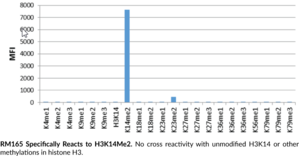
Histone H3 is a nuclear protein and a component of the nucleosome core, a basic unit of chromatin, that is essential for organizing genomic DNA in eukaryotic nuclei.1 It is a globular protein that contains an unstructured N-terminal tail that extends outside of the nucleosome core and is subject to various post-translational modifications (PTMs), including methylation, phosphorylation, acetylation, and citrullination.1,2 Dimethylation of histone 3 lysine 14 (H3K14Me2) is enriched in the promoter region of tumor suppressor candidate 3 (TUSC3), but not that of GAPDH, in DLD-1 and HCT116 cells.3 Ubiquitin-like PHD and RING finger domain-containing protein 1 (UHRF1) can bind to dimethylated H3K14 and suppress acetylation of H3K14. H3K14Me2 levels increase during transdifferentiation of rat Thy-1(+) Lin(-) bone marrow cells into hepatocytes in vitro.4 Cayman’s Histone H3K14Me2 Monoclonal Antibody (RM165) can be used for ELISA, multiplex-based assay, and Western blot (WB) applications.
WARNING This product is not for human or veterinary use.
References & Product Citations
1. Writing, erasing and reading histone lysine methylations. Exp. Mol. Med. 49(4), e324 (2017).
2. Histone posttranslational modifications: Potential role in diagnosis, prognosis, and therapeutics of cancer. Prognostic Epigenetics 15, 351-373 (2019).
3. UHRF1-
4. Epigenetic modifications of histone H3 during the transdifferentiation of Thy-
Contact Info
Cayman Chemical1180 East Ellsworth RoadAnn Arbor, Michigan 48108 USAToll Free: (800) 364-9897(USA and Canada only)Fax: (734) 971-3640


