
Technical Support & Resources
Visit our FAQ
Contact Us
Toll Free Phone (USA and Canada Only): (888) 526-5351
Direct Phone: (734) 975-3888
Product Categories

Technical Information
Shipping & Storage Information
Recommended Products
Certificates of Analysis & Batch Specific Data
Provide batch numbers separated by commas to download or request available product inserts, QC sheets, certificates of analysis, data packs, and GC-MS data.

Visit Our Cancer Resource Center
Find Tools & Resources to Study the Hallmarks of Cancer
- Cancer cell signaling & regulation
- Cancer metabolism
- Tumor microenvironment
Product Description
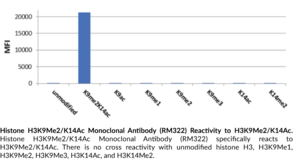
Histone H3 is a nuclear protein and a component of the nucleosome core, a basic unit of chromatin, that is essential for organizing genomic DNA in eukaryotic nuclei.1 It is a globular protein that contains an unstructured N-terminal tail that extends outside of the nucleosome core and is subject to various post-translational modifications (PTMs), including methylation, phosphorylation, acetylation, and citrullination.1,2 Dimethylation of histone H3 at lysine 9 (H3K9Me2) is associated with transcriptional repression, whereas acetylation of histone H3 at lysine 14 (H3K14Ac) is associated with transcriptional activation.3,4 H3K9Me2/K14Ac levels are increased in mouse differentiated embryonic stem cells (ESCs) compared with undifferentiated ESCs.5 Altered H3K9Me2/K14Ac levels have been found in tumor biopsies from patients with HER2+, triple-negative, luminal A-like, or luminal B-like breast cancer.6 Cayman's Histone H3K9Me2/K14Ac Monoclonal Antibody (RM322) recognizes histone H3 only when modified by both dimethylation at K9 and acetylation at K14. This antibody can be used for multiplex-based assay and Western blot (WB) applications.
WARNING This product is not for human or veterinary use.
References & Product Citations
1. Writing, erasing and reading histone lysine methylations. Exp. Mol. Med. 49(4), e324 (2017).
2. Histone posttranslational modifications: Potential role in diagnosis, prognosis, and therapeutics of cancer. Prognostic Epigenetics 15, 351-373 (2019).
3. Genomic prevalence of heterochromatic H3K9me2 and transcription do not discriminate pluripotent from terminally differentiated cells. PLoS Genet. 7(6), e1002090 (2011).
4. Epigenetics in diabetic nephropathy, immunity and metabolism. Diabetologia 61(1), 6-20 (2018).
5. Histone H4 acetylation and the epigenetic reader Brd4 are critical regulators of pluripotency in embryonic stem cells. BMC Genomics. 17, 95 (2016).
6. Pathology tissue-
Contact Info
Cayman Chemical1180 East Ellsworth RoadAnn Arbor, Michigan 48108 USAToll Free: (800) 364-9897(USA and Canada only)Fax: (734) 971-3640


