
Technical Support & Resources
Visit our FAQ
Contact Us
Toll Free Phone (USA and Canada Only): (888) 526-5351
Direct Phone: (734) 975-3888
Product Categories
Technical Information
- Acetylated Histone H4 Lysine 5
Shipping & Storage Information
Recommended Products
Certificates of Analysis & Batch Specific Data
Provide batch numbers separated by commas to download or request available product inserts, QC sheets, certificates of analysis, data packs, and GC-MS data.

Visit Our Cancer Resource Center
Find Tools & Resources to Study the Hallmarks of Cancer
- Cancer cell signaling & regulation
- Cancer metabolism
- Tumor microenvironment
Product Description
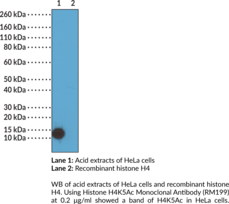
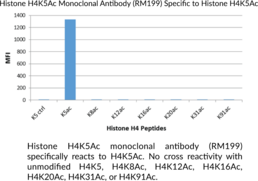
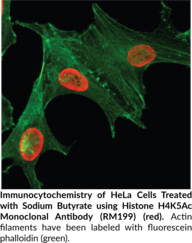
Histone H4 is one of four core histone proteins that are involved in the organization of DNA into chromatin.1 Histones are globular proteins with unstructured N-terminal tails and are subject to a variety of posttranslational modifications, such as methylation, acetylation, phosphorylation, and citrullination, that can influence chromatin structure and regulate gene transcription.1,2 Acetylation of histone H4 at lysine 5 (H4K5Ac) is enriched in promoter regions and coding sequences in mouse hippocampus and is associated with active chromatin.3,4 Hippocampal levels of H4K5Ac increase following contextual fear conditioning in mice.3 Levels of H4K5Ac are elevated in postmortem brain tissue isolated from fetuses with spina bifida compared with healthy controls.5 Global levels of H4K5Ac are decreased in blast cells from patients with acute myeloid leukemia compared with healthy individuals, and low levels of H4K5Ac are associated with poor prognosis in these patients.6 Cayman's Histone H4K5Ac Monoclonal Antibody (RM199) can be used for ELISA, immunocytochemistry (ICC), multiplex-based assay, and Western blot (WB) applications.
WARNING This product is not for human or veterinary use.
References & Product Citations
1. Histone hypercitrullination mediates chromatin decondensation and neutrophil extracellular trap formation. J. Cell Biol. 184(2), 205-213 (2009).
2. Writing, erasing and reading histone lysine methylations. Exp. Mol. Med. 49(4), e324 (2017).
3. Genome-
4. Gene bookmarking accelerates the kinetics of post-
5. Identification of histone acetylation markers in human fetal brains and increased H4K5ac expression in neural tube defects. Mol. Genet. Genomic Med. 7(12), e1002 (2019).
6. MYST2 acetyltransferase expression and Histone H4 Lysine acetylation are suppressed in AML. Exp. Hematol. 43(9), 794-802 (2015).
Contact Info
Cayman Chemical1180 East Ellsworth RoadAnn Arbor, Michigan 48108 USAToll Free: (800) 364-9897(USA and Canada only)Fax: (734) 971-3640


