
Technical Support & Resources
Visit our FAQ
Contact Us
Toll Free Phone (USA and Canada Only): (888) 526-5351
Direct Phone: (734) 975-3888
N-Cadherin Monoclonal Antibody (Clone RM259)
Item No. 32208
Technical Information
- Neural cadherin
- Cadherin-2
- CDH2
Shipping & Storage Information
Recommended Products
Certificates of Analysis & Batch Specific Data
Provide batch numbers separated by commas to download or request available product inserts, QC sheets, certificates of analysis, data packs, and GC-MS data.

Visit Our Cancer Resource Center
Find Tools & Resources to Study the Hallmarks of Cancer
- Cancer cell signaling & regulation
- Cancer metabolism
- Tumor microenvironment
Product Description
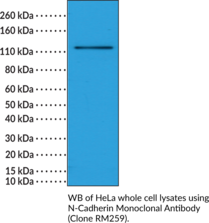
N-cadherin is an adhesion molecule that mediates the formation of adherens junctions and regulates tissue formation and neural development.1,2 It is a transmembrane glycoprotein that contains an extracellular cadherin domain that forms cell-cell interactions, a transmembrane domain, and a cytoplasmic domain that interacts with a variety of adaptor proteins, including β-catenin, to influence cytoskeletal dynamics.1 N-cadherin is widely expressed in the nervous system, as well as in osteoblasts, endothelial cells, and stromal cells, and localizes to the cell surface where it forms adherens junctions that stabilize FGFR, activating ERK/MAPK signaling and promoting cell survival and migration.2 N-cadherin cell surface expression is regulated by endocytosis and is required for neuronal patterning and regulation of FGFR activity.3 Upregulation of N-cadherin is a key feature of the epithelial-mesenchymal transition (EMT), a process that promotes tumorigenesis and cancer metastasis.1 Tumor N-cadherin levels are increased in patients with a variety of epithelial or non-epithelial solid cancers, including lung, breast, or skin, and are associated with decreased overall survival.4 Cayman’s N-Cadherin Rabbit Monoclonal Antibody (Clone RM259) can be used for Western blot (WB) applications.
WARNING This product is not for human or veterinary use.
References & Product Citations
1. Aberrant N-
2. The E-
3. Adherens junction turnover: regulating adhesion through cadherin endocytosis, degradation, and recycling. Subcell. Biochem. 60, 197-222 (2012).
4. N-
Contact Info
Cayman Chemical1180 East Ellsworth RoadAnn Arbor, Michigan 48108 USAToll Free: (800) 364-9897(USA and Canada only)Fax: (734) 971-3640


