
Technical Support & Resources
Visit our FAQ
Contact Us
Toll Free Phone (USA and Canada Only): (888) 526-5351
Direct Phone: (734) 975-3888
Product Categories
Technical Information
Shipping & Storage Information
Recommended Products
Certificates of Analysis & Batch Specific Data
Provide batch numbers separated by commas to download or request available product inserts, QC sheets, certificates of analysis, data packs, and GC-MS data.
Kinase Resource Center
Discover Products & Resources for Kinase Research
- Kinase inhibitors, screening libraries, assay kits, & more
- Tools to study kinase signaling pathways:
- Growth factor signaling
- PI3K/Akt/mTOR
- MAPKs (ERK, p38, & JNK)
- JAK/STAT signaling
- Articles, resources, & advice
Product Description
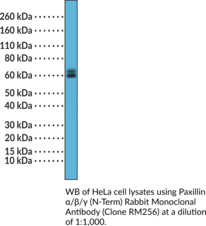
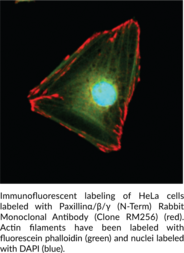
Paxillin is a focal adhesion adapter protein that facilitates the assembly of multiprotein complexes that mediate signal transduction between the extracellular matrix and actin cytoskeleton.1,2,3 It contains four LIM domains in the C-terminal region that target paxillin to focal adhesions and an N-terminal region with five LD motifs that serve as docking sites for a variety of proteins, including vinculin, focal adhesion kinase (FAK), and Src, that facilitate intracellular signal transduction.3 Alternative splicing of PXN generates three isoforms, α, β, and γ, that contain a variable N-terminus, as well as a fourth isoform, δ, that lacks the N-terminal region.3 Paxillin is expressed in most tissues and predominately localizes to focal adhesions on the cell membrane.2,3 Upon cytokine or growth factor stimulation or cell adhesion, paxillin is phosphorylated by a variety of kinases, including FAK and ERK, providing a scaffold for signaling proteins that are involved in the formation and regulation of focal adhesions, which mediate cell migration.3 It is also expressed in the cytoplasm and nucleus where it regulates gene transcription. Tumor paxillin levels are increased in patients with glioblastoma multiforme (GBM) and associated with poor survival. Cayman’s Paxillinα/β/γ (N-Term) Rabbit Monoclonal Antibody (Clone RM256) can be used for immunocytochemistry (ICC) and Western blot (WB) applications.
WARNING This product is not for human or veterinary use.
References & Product Citations
1. Paxillin actions in the nucleus. Steroids 133, 87-92 (2018).
2. FAK and paxillin, two potential targets in pancreatic cancer. Oncotarget 7(21), 31586-31601 (2016).
3. Paxillin: A crossroad in pathological cell migration. J. Hematol. Oncol. 10(1), 50 (2017).
Contact Info
Cayman Chemical1180 East Ellsworth RoadAnn Arbor, Michigan 48108 USAToll Free: (800) 364-9897(USA and Canada only)Fax: (734) 971-3640


