
Technical Support & Resources
Visit our FAQ
Contact Us
Toll Free Phone (USA and Canada Only): (888) 526-5351
Direct Phone: (734) 975-3888
Product Categories
Application
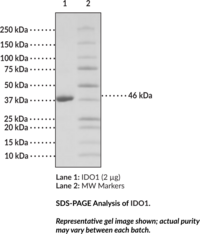
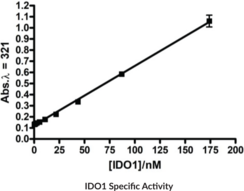
Technical Information
- Indoleamine 2,3-dioxygenase 1
- Indoleamine-pyrrole 2,3-dioxygenase
Shipping & Storage Information
Recommended Products
Certificates of Analysis & Batch Specific Data
Provide batch numbers separated by commas to download or request available product inserts, QC sheets, certificates of analysis, data packs, and GC-MS data.

Visit Our Cancer Resource Center
Find Tools & Resources to Study the Hallmarks of Cancer
- Cancer cell signaling & regulation
- Cancer metabolism
- Tumor microenvironment
Product Description
Indoleamine 2,3-dioxygenase 1 (IDO1) is a cytosolic heme-containing enzyme involved in tryptophan catabolism that mediates multiple immunomodulatory processes.1,2 It exists as a monomer and is composed of a large catalytic domain, which contains the heme group, and a small non-catalytic domain with two immunoreceptor tyrosine-based inhibition motifs (ITIMs) that regulate intracellular signaling.3,4 IDO1 catalyzes the oxidation of L-tryptophan (Item No. 29600) to N-formylkynurenine, the first and rate-limiting step of the kynurenine pathway, leading to the production of several metabolites of kynurenine (Item No. 11305), including 3-hydroxy anthranilic acid (Item No. 20512), that have immunoprotective and immunosuppressive effects.1 IDO1 is widely expressed in several lymphoid and non-lymphoid organs, including lymph nodes, spleen, tonsils, lungs, and intestine, as well as immune cells, including macrophages and dendritic cells (DCs), and endothelial cells.1 IDO1 activity is regulated at the transcriptional level where expression of IDO1 is increased by the transcription factors NF-κB, aryl hydrocarbon receptor (AhR), and CCTF, which are induced by stimulation with toll-like receptor (TLR) ligands or cytokines and inhibited by hypoxia.1 IDO1 activity can also be inhibited at the protein level by peroxynitrite (Item No. 81565), leading to IDO1 inactivation, or suppressor of cytokine signaling 3 (SOCS3), which binds to and targets IDO1 for proteasomal degradation. Increased IDO1 activity is associated with numerous pathological conditions, including atherosclerosis, autoimmunity, HIV, and cancer. Cayman's IDO1 (human, recombinant) protein can be used for enzyme assay applications. This protein consists of 402 amino acids and has a calculated molecular weight of 46 kDa.
WARNING This product is not for human or veterinary use.
References & Product Citations
1. The role of indoleamine-
2. Challenges in the discovery of indoleamine 2,3-
3. Advances in indoleamine 2,3-
4. Targeting the IDO1/TDO2–KYN–AhR pathway for cancer immunotherapy – challenges and opportunities. Trends Pharmacol. Sci. 39(3), 307-325 (2018).
Contact Info
Cayman Chemical1180 East Ellsworth RoadAnn Arbor, Michigan 48108 USAToll Free: (800) 364-9897(USA and Canada only)Fax: (734) 971-3640


