
Technical Support & Resources
Visit our FAQ
Contact Us
Toll Free Phone (USA and Canada Only): (888) 526-5351
Direct Phone: (734) 975-3888
Product Categories
Product Type
Application
Technical Information
- ADPRT
- ADPRT2
- ADPRTL2
- ARTD2
- Poly (ADP-ribose) Polymerase 2
- Poly(ADP-ribosyl)transferase 2
Shipping & Storage Information
Recommended Products
Certificates of Analysis & Batch Specific Data
Provide batch numbers separated by commas to download or request available product inserts, QC sheets, certificates of analysis, data packs, and GC-MS data.

Visit Our Cancer Resource Center
Find Tools & Resources to Study the Hallmarks of Cancer
- Cancer cell signaling & regulation
- Cancer metabolism
- Tumor microenvironment
Product Description
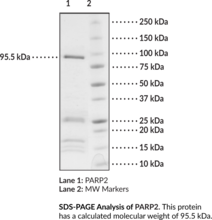
Poly(ADP-Ribose) polymerase 2 (PARP2) is an ADP-ribosylating enzyme with a role in the DNA damage response (DRR).1,2 It is composed of a natively disordered N-terminal region containing a nuclear localization sequence, a central Trp-Gly-Arg (WGR) domain that is essential to DNA damage-dependent catalytic domain activity, and a C-terminal catalytic domain (CAT) that contains an ADP-ribosyltransferase fold and a regulatory helical subdomain.2 PARP2 is ubiquitously expressed and localized to the nucleus where it is preferentially activated by the presence of PARP1-induced poly(ADP)-ribosylation (PARylation) induced by PARP1 (Item No. 32561) at sites of single-stranded DNA breaks. The WGR domain binds directly to DNA and activates PAR catalytic activity and branched PAR chain synthesis through cross-talk with the helical subdomain.1,2 PARP2 PARylates itself and other proteins, including transcription factors, influencing multiple biological processes, such as transcription, genome maintenance, and cell signaling.3 PARP2 expression is negatively correlated with the amount of tumor immune infiltrate in tumor samples isolated from patients with osteosarcoma.4 Cayman’s PARP2 (human, recombinant) protein can be used for enzyme assay applications. This protein consists of 582 amino acids and has a calculated molecular weight of 95.5 kDa.
WARNING This product is not for human or veterinary use.
References & Product Citations
1. PARP2 mediates branched poly ADP-
2. PARP-
3. Understanding specific functions of PARP-
4. Immuno-
Contact Info
Cayman Chemical1180 East Ellsworth RoadAnn Arbor, Michigan 48108 USAToll Free: (800) 364-9897(USA and Canada only)Fax: (734) 971-3640


