
Technical Support & Resources
Visit our FAQ
Contact Us
Toll Free Phone (USA and Canada Only): (888) 526-5351
Direct Phone: (734) 975-3888
Product Categories
Application
Technical Information
- PKCA
- PKC-A
- PRKCA
- Protein Kinase C Alpha Type
Shipping & Storage Information
Recommended Products
Certificates of Analysis & Batch Specific Data
Provide batch numbers separated by commas to download or request available product inserts, QC sheets, certificates of analysis, data packs, and GC-MS data.
Kinase Resource Center
Discover Products & Resources for Kinase Research
- Kinase inhibitors, screening libraries, assay kits, & more
- Tools to study kinase signaling pathways:
- Growth factor signaling
- PI3K/Akt/mTOR
- MAPKs (ERK, p38, & JNK)
- JAK/STAT signaling
- Articles, resources, & advice
Product Description
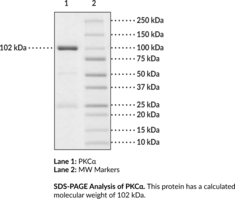
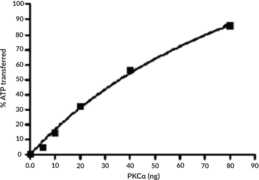
PKCα is an α-type conventional isoform of the PKC family of serine/threonine protein kinases, which includes the conventional isoforms PKCα, -β, and -γ, the novel isoforms PKCδ, -ε, -η, and -θ, and the atypical isoforms PKCζ and -λ/ι.1 PKCα is composed of an N-terminal regulatory domain containing a pseudosubstrate binding site, a C1 domain that binds the cofactor diacylglycerol (DAG), a C2 domain that binds the cofactor calcium, and a C-terminal domain containing an ATP-binding domain, substrate binding site, and catalytic domain. PKCα is ubiquitously expressed and localized to the cytoplasm in an auto-inhibited conformation until activated by calcium and DAG, which are both required for activation of the conventional PKC isoforms.1,2 Activation of PKCα occurs via an allosteric and temporal mechanism during which it is translocated primarily to the plasma membrane where it phosphorylates a wide variety of substrates.1 PKCα is involved in the regulation of cell survival with anti- or pro-apoptotic effects and an increase or decrease in cell proliferation depending on the cellular context and cell type. It is also involved in cell differentiation and motility.2 Protein levels of PKCα are either increased or decreased in cancer cells, indicating a complex role in oncogenesis.3 Tumor levels of PKCα correlate positively to tumor grade and negatively to survival in patients with breast cancer.4 A SNP in PRKCA, which encodes PKCα, is associated with an increased risk of post-traumatic stress disorder (PTSD) in survivors of genocide.5 Cayman’s PKCα (human, recombinant) protein can be used for enzyme assay applications. This protein consists of 672 amino acids and has a calculated molecular weight of 102 kDa.
WARNING This product is not for human or veterinary use.
References & Product Citations
1. Protein kinase C isoforms: Multi-
2. Protein kinase Cα (PKCα): Regulation and biological function. J. Biochem. 132(5), 669-675 (2002).
3. Classical PKC isoforms in cancer. Pharmacol. Res. 55(6), 477-486 (2007).
4. PKCα expression is a marker for breast cancer aggressiveness. Mol. Cancer 9, 76 (2010).
5. PKCα is genetically linked to memory capacity in healthy subjects and to risk for posttraumatic stress disorder in genocide survivors. Proc. Natl. Acad. Sci. USA 109(22), 8746-8751 (2012).
Contact Info
Cayman Chemical1180 East Ellsworth RoadAnn Arbor, Michigan 48108 USAToll Free: (800) 364-9897(USA and Canada only)Fax: (734) 971-3640


