
Technical Support & Resources
Visit our FAQ
Contact Us
Toll Free Phone (USA and Canada Only): (888) 526-5351
Direct Phone: (734) 975-3888
Product Categories
Application
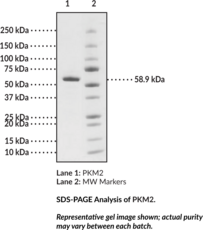
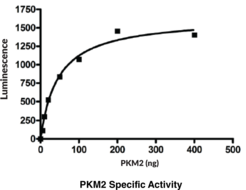
Technical Information
- CTHBP
- Cytosolic Thyroid Hormone-binding Protein
- OIP3
- Opa-interacting Protein 3
- Pyruvate Kinase Muscle 2
- THBP1
- Thyroid Hormone-binding Protein 1
Shipping & Storage Information
Recommended Products
Certificates of Analysis & Batch Specific Data
Provide batch numbers separated by commas to download or request available product inserts, QC sheets, certificates of analysis, data packs, and GC-MS data.
Kinase Resource Center
Discover Products & Resources for Kinase Research
- Kinase inhibitors, screening libraries, assay kits, & more
- Tools to study kinase signaling pathways:
- Growth factor signaling
- PI3K/Akt/mTOR
- MAPKs (ERK, p38, & JNK)
- JAK/STAT signaling
- Articles, resources, & advice
Product Description
Pyruvate kinase (PK) is an enzyme that catalyzes the transfer of a phosphate group from phosphoenolpyruvate to ADP during aerobic glycolysis.1 PKM2 is an isoform of PK encoded by PKM in humans that is primarily expressed during embryonic development and localized to the cytosol. PKM2 expression is attenuated in adult tissues, however, it is reactivated in cancer cells during tumor development.1,2,3 It functions as a tetramer in the cytosol that is formed or dissociated in response to post-translational modifications and various allosteric regulators, such as fructose-1,6-bisphosphate, as well as the oxidation of its cysteine residues.4 It interacts with various tyrosine kinases, such as Bcr-Abl, A-RAF, and FGFR1, in a reciprocal interaction that regulates PKM2 enzyme kinetics and kinase signaling.2 PKM2 also functions as a dimer that can translocate to the nucleus and activate various transcription factors, including STAT3, NF-κB, and HIF-1α, to induce gene transcription.3,2 Levels of PKM2 are increased in mesothelioma, osteosarcoma, and hepatomas, as well as ovarian, breast, gallbladder, and gastric cancers, and are associated with poor prognosis. Cayman’s PKM2 (human, recombinant) protein can be used for enzyme assay applications.
WARNING This product is not for human or veterinary use.
References & Product Citations
1. Chapter four -
2. Pyruvate kinase M2 fuels multiple aspects of cancer cells: From cellular metabolism, transcriptional regulation to extracellular signaling. Mol. Cancer 17(1), 35 (2018).
3. PKM2, function and expression and regulation. Cell Biosci. 9, 52 (2019).
4. Chapter one -
Contact Info
Cayman Chemical1180 East Ellsworth RoadAnn Arbor, Michigan 48108 USAToll Free: (800) 364-9897(USA and Canada only)Fax: (734) 971-3640


