
Features
- Screen test samples to quantify functional activity, either agonist or antagonist, that they may exert against human EGFR1
- Robust technology provides sustained response for consistent and reproducible data acquisition
- Included in kit: Ready-to-use, pre-transfected reporter cells | Optimized media | Positive control agonist | Luciferase Detection Reagent | Cell culture ready assay plate
Technical Support & Resources
Visit our FAQ
Contact Us
Toll Free Phone (USA and Canada Only): (888) 526-5351
Direct Phone: (734) 975-3888
Product Categories
Product Type
Application
Technical Information
- EGFR1
- ErbB-1
- HER1
Shipping & Storage Information
Recommended Products
Certificates of Analysis & Batch Specific Data
Provide batch numbers separated by commas to download or request available product inserts, QC sheets, certificates of analysis, data packs, and GC-MS data.

Kinase Resource Center
Discover Products & Resources for Kinase Research
- Kinase inhibitors, screening libraries, assay kits, & more
- Tools to study kinase signaling pathways:
- Growth factor signaling
- PI3K/Akt/mTOR
- MAPKs (ERK, p38, & JNK)
- JAK/STAT signaling
- Articles, resources, & advice
Product Description
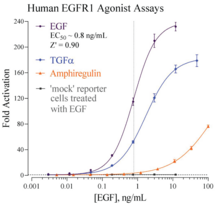
EGFR1 is a single-pass transmembrane receptor, one of four members of the receptor tyrosine kinase (RTK) family. Binding interactions with extracellular signaling peptides such as epidermal growth factor (EGF), transforming growth factor alpha (TGF-α), or amphiregulin lead to receptor dimerization and autophosphorylation and activation of associated intracellular signaling proteins. Interestingly, EGF Receptors demonstrate two alternative signal processing modes: one via the membrane-bound receptor and signaling at cell surface; and the other signaling through internalized receptors, nuclear translocation, and co-association with activated transcription factors to interact directly with target gene promoter sequences. Activated EGF Receptors are known to signal through several different pathways, including those mediated by Ras, PI3K, PLC-γ, and JAK, culminating in the activation of specific transcription factors and the induction of respective target genes. Phosphorylation and activation of the transcription factor STAT3 is one prominent pathway utilized by EGFR1, and it is the signaling mechanism exploited by the reporter cells in the INDIGO kit.
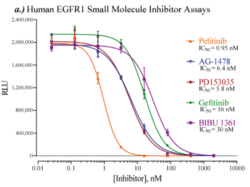
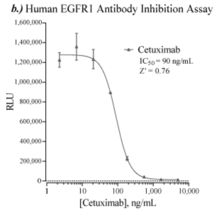
INDIGO's reporter cells contain the luciferase gene functionally linked to an upstream minimal promoter and tandem STAT3 genetic response element (GRE) sequences. Activated, dimeric STAT3P (or STAT3P associated with nuclear EGFR1P) bind the STAT3 GREs to initiate the formation of a complete transcription complex that drives Luc expression. Quantifying relative changes in luciferase activity in the treated reporter cells relative to the untreated cells provides a sensitive, dose-dependent surrogate measure of drug- or antibody-induced changes in EGFR1 activity. Considering their significant role in rapid cell proliferation, and their involvement in the progression of many types of cancers, EGFR continues to command much interest as a target for the development of novel, specific, and predominantly inhibitory drugs and antibodies. Accordingly, the primary application of this EGFR1 Reporter Assay is to screen test materials for any functional activity, either against or inhibitory, that they may exert against the EGFR1.
Reporter Cells are transiently transfected and prepared as frozen stocks using INDIGO's proprietary CryoMite™ process. This cryo-preservation method allows for the immediate dispensing healthy, division-competent reporter cells into assay plates. There is no need for cumbersome intermediate treatment steps such as spin-and-rinse of cells, viability determinations, or cell titer adjustments prior to assay setup. [INDIGO Catalog Item Nos. IB13001, IB13001-32, IB13002]
WARNING This product is not for human or veterinary use.
Contact Info
Cayman Chemical1180 East Ellsworth RoadAnn Arbor, Michigan 48108 USAToll Free: (800) 364-9897(USA and Canada only)Fax: (734) 971-3640


