
Technical Support & Resources
Visit our FAQ
Contact Us
Toll Free Phone (USA and Canada Only): (888) 526-5351
Direct Phone: (734) 975-3888
Product Categories
Technical Information
- p160 ROCK1
- Renal Carcinoma Antigen NY-REN-35
- Rho-associated, Coiled-coil-containing Protein Kinase 1
- Rho-associated Protein Kinase 1
Shipping & Storage Information
Recommended Products
Certificates of Analysis & Batch Specific Data
Provide batch numbers separated by commas to download or request available product inserts, QC sheets, certificates of analysis, data packs, and GC-MS data.
Kinase Resource Center
Discover Products & Resources for Kinase Research
- Kinase inhibitors, screening libraries, assay kits, & more
- Tools to study kinase signaling pathways:
- Growth factor signaling
- PI3K/Akt/mTOR
- MAPKs (ERK, p38, & JNK)
- JAK/STAT signaling
- Articles, resources, & advice
Product Description
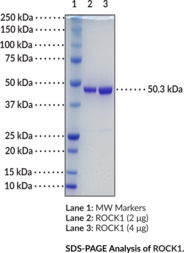
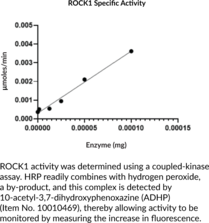
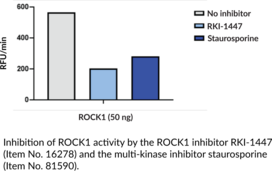
Rho-associated protein kinase 1 (ROCK1) is a serine/threonine kinase that has roles in cytoskeletal organization, as well as cell survival, proliferation, and apoptosis.1,2 It exists as a homodimer where each monomer is composed of an N-terminal kinase domain, a coiled-coil region that contains the Rho-binding domain, and a C-terminal pleckstrin homology (PH) domain that contains a cysteine-rich C1 domain and acts as an autoinhibitory region.3,2 Rock1 mRNA is expressed in all tissues except in the muscle and brain, and the protein is localized predominantly in the cytosol but also associates with the plasma membrane and centrosomes.2,1 Binding of ROCK1 to GTP-bound RhoA induces activation of ROCK1, which phosphorylates a variety of downstream targets, including myosin light chain (MLC) phosphatase 1 (MYPT1) and MLC2, that have diverse roles in cytoskeletal organization.2 The C-terminal autoinhibitory region of ROCK1 is cleaved by caspase-3 during the execution phase of apoptosis, resulting in constitutively active ROCK1 and plasma membrane blebbing, a hallmark of apoptosis.1,2 ROCK1 is overexpressed in tumors from patients with various solid tumors, including hepatocellular carcinoma, glioblastoma, or melanoma, and increased tumor ROCK1 mRNA transcript levels are correlated with increased metastasis and reduced overall survival in patients with breast cancer.4,5 Cayman’s ROCK1 (human, recombinant) protein can be used for ELISA, enzyme activity assay, and Western blot (WB) applications.
WARNING This product is not for human or veterinary use.
References & Product Citations
1. The function of Rho-
2. Rho-
3. RhoBTB1 interacts with ROCKs and inhibits invasion. Biochem. J. 476(17), 2499-2514 (2019).
4. ROCK1 promotes migration and invasion of non‑small‑cell lung cancer cells through the PTEN/PI3K/FAK pathway. Int. J. Oncol. 55(4), 833-844 (2019).
5. The expression and prognostic value of ROCK I and ROCK II and their role in human breast cancer. Int. J. Oncol. 33(3), 585-593 (2008).
Contact Info
Cayman Chemical1180 East Ellsworth RoadAnn Arbor, Michigan 48108 USAToll Free: (800) 364-9897(USA and Canada only)Fax: (734) 971-3640


