
Technical Support & Resources
Information provided in the product description is from published literature. Due to the nature of scientific experimentation, your results (e.g., selectivity and effective concentrations) or specific application for this product may differ. If you have questions about how this product fits your application, please contact our technical support staff.
Visit our FAQ
Contact Us
Toll Free Phone (USA and Canada Only): (888) 526-5351
Direct Phone: (734) 975-3888
Product Categories
Research Area
Technical Information
- DPP
Shipping & Storage Information
Recommended Products
Certificates of Analysis & Batch Specific Data
Provide batch numbers separated by commas to download or request available product inserts, QC sheets, certificates of analysis, data packs, and GC-MS data.
Product Description
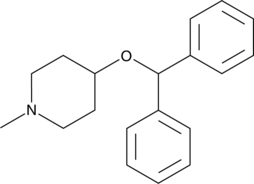
Diphenylpyraline is a first generation histamine H1 receptor antagonist (Ki = 20 nM in a radioligand binding assay using bovine cerebral cortex membranes).1,2 It also inhibits muscarinic acetylcholine receptors (Ki = 0.84 nM).2 Diphenylpyraline (1 and 3 µM) inhibits contractions induced by prostaglandin E1 (PGE1; Item No. 13010) in isolated guinea pig ileum.3 It inhibits ovalbumin-induced bronchoconstriction in ovalbumin-sensitized guinea pigs when administered intravenously at a dose of 20 µmol/kg.4 Diphenylpyraline (14 mg/kg) also reduces dopamine uptake in rat nucleus accumbens.1 Formulations containing diphenylpyraline have been used in the treatment of allergic rhinitis.
WARNING This product is not for human or veterinary use.
References & Product Citations
1. Effects of the histamine H1 receptor antagonist and benztropine analog diphenylpyraline on dopamine uptake, locomotion and reward. Eur. J. Pharmacol. 683(1-3), 161-165 (2012).
2. Antimuscarinic effects of antihistamines: Quantitative evaluation by receptor-
3. A possible approach to the suppression of side effects induced by PGE1. Prostaglandins Leukot. Essent. Fatty Acids 52(1), 17-20 (1995).
4. The effects of H2-
Contact Info
Cayman Chemical1180 East Ellsworth RoadAnn Arbor, Michigan 48108 USAToll Free: (800) 364-9897(USA and Canada only)Fax: (734) 971-3640


