
Technical Support & Resources
Visit our FAQ
Contact Us
Toll Free Phone (USA and Canada Only): (888) 526-5351
Direct Phone: (734) 975-3888
Product Categories
Product Type
Research Area
Application

Technical Information
- CD203a
- Ectonucleotide Pyrophosphatase/Phosphodiesterase 1
- Ectonucleotide Pyrophosphatase/Phosphodiesterase Family Member 1
- Membrane Component Chromosome 6 Surface Marker 1
- PDNP1
- Plasma Cell Membrane Glycoprotein PC-1
Shipping & Storage Information
Recommended Products
Certificates of Analysis & Batch Specific Data
Provide batch numbers separated by commas to download or request available product inserts, QC sheets, certificates of analysis, data packs, and GC-MS data.

Explore Obesity & Metabolic Disease Resources
Discover high-quality research tools to investigate GLP-1 mechanisms and next-generation metabolic targets.
OBESITY RESEARCH SOLUTIONSProduct Description
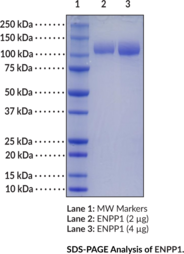
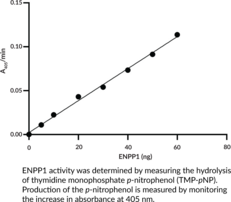
Ectonucleotide pyrophosphatase/phosphodiesterase family member 1 (ENPP1) is a type II transmembrane glycoprotein with nucleotide pyrophosphatase and phosphodiesterase enzyme activities.1 It is expressed in skeletal, adipose, hepatic, renal, cardiac, and placental tissues, as well as pancreatic islets, salivary glands, chondrocytes, fibroblasts, and lymphocytes.2 ENPP1 is a critical regulator of purinergic signaling that catalyzes the hydrolysis of ATP or GTP to AMP or GMP, respectively, as well as the hydrolysis of cGAMP, and has roles in platelet aggregation, muscle contraction, hypoxia, ischemia, cGAS-STING signaling, and cell proliferation, migration, apoptosis, and differentiation.1,3 This nucleotide hydrolysis also generates inorganic pyrophosphates, which inhibit bone and cartilage mineralization, implicating ENPP1 as a regulator of bone and cartilage development. Loss-of-function mutations in ENPP1 are associated with various calcification-related disorders, including autosomal recessive hypophosphatemic rickets type 2 (ARHR2) generalized arterial calcification of infancy (GACI), and pseudoxanthoma elasticum (PXE).1,4 ENPP1 SNPs are associated with insulin resistance and the development of diabetic nephropathy.2,5 ENPP1 hydrolysis of cGAMP in the tumor microenvironment decreases STING activation, facilitates immunosuppression, and is associated with enhanced bone metastasis in mouse xenograft models of breast cancer.1,3 Inhibition of ENPP1 promotes STING activation and increases survival in various mouse xenograft models.1 Cayman’s ENPP1 (human, recombinant) protein can be used for enzyme activity assays.
WARNING This product is not for human or veterinary use.
References & Product Citations
1. ENPP1, an old enzyme with new functions, and small molecule inhibitors -
2. The role of ecto-
3. Hydrolysis of 2'3'-
4. Genetic pathways of vascular calcification. Trends Cardiovasc. Med. 22(4), 93-98 (2012).
5. ENPP1 gene, insulin resistance and related clinical outcomes. Curr. Opin. Clin. Nutr. Metab. Care 10(4), 403-409 (2007).
Contact Info
Cayman Chemical1180 East Ellsworth RoadAnn Arbor, Michigan 48108 USAToll Free: (800) 364-9897(USA and Canada only)Fax: (734) 971-3640


