
Technical Support & Resources
Visit our FAQ
Contact Us
Toll Free Phone (USA and Canada Only): (888) 526-5351
Direct Phone: (734) 975-3888
Technical Information
- CT-1
- CT1
- CTF1
Shipping & Storage Information
Recommended Products
Certificates of Analysis & Batch Specific Data
Provide batch numbers separated by commas to download or request available product inserts, QC sheets, certificates of analysis, data packs, and GC-MS data.
Kinase Resource Center
Discover Products & Resources for Kinase Research
- Kinase inhibitors, screening libraries, assay kits, & more
- Tools to study kinase signaling pathways:
- Growth factor signaling
- PI3K/Akt/mTOR
- MAPKs (ERK, p38, & JNK)
- JAK/STAT signaling
- Articles, resources, & advice
Product Description
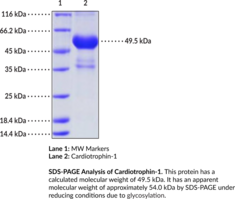
Cardiotrophin-1 is a glycosylated polypeptide and member of the IL-6 family of cytokines.1 It is composed of four α-helices but lacks the hydrophobic N-terminal secretion signal sequence that most IL-6 family proteins contain.2 Cardiotrophin-1 is primarily expressed in embryonic and adult cardiomyocytes, but it is also expressed in skeletal muscle, as well as the liver, lungs, and kidneys.1,3 Its expression is increased under cellular stress conditions, such as hypoxic stress.1 Cardiotrophin-1 forms a heterocomplex with gp130 and leukemia inhibitory factor receptor β (LIFRβ) in cardiomyocytes and, in other cells, with gp130, LIFRβ, and cytokine-specific α-chains, which signal through the JAK/STAT, ERK/MAPK, and PI3K/AKT pathways. It induces cardiomyocyte hypertrophy in vitro, and levels of cardiotrophin-1 are increased in the heart in animal models after myocardial infarction and protect the heart from ischemic injury.1 Serum levels of cardiotrophin-1 are increased in patients with heart failure and hypertensive disease.2 It has both protective or detrimental effects in various tissues, including the heart, kidney, and vasculature.3,1 Cayman’s Cardiotrophin-1 (human, recombinant) protein is a disulfide-linked homodimer. The reduced monomer, composed of cardiotrophin-1 (amino acids 2-201) fused to human IgG1 at its N-terminus, consists of 460 amino acids and has a calculated molecular weight of 49.5 kDa. As a result of glycosylation, the monomer migrates at approximately 54 kDa by SDS-PAGE under reducing conditions.
WARNING This product is not for human or veterinary use.
References & Product Citations
1. Effects and mechanism of organ protection by cardiotrophin-
2. Cardiotrophin-
3. Update on the pathophysiological activities of the cardiac molecule cardiotrophin-
Contact Info
Cayman Chemical1180 East Ellsworth RoadAnn Arbor, Michigan 48108 USAToll Free: (800) 364-9897(USA and Canada only)Fax: (734) 971-3640


