
Technical Support & Resources
Visit our FAQ
Contact Us
Toll Free Phone (USA and Canada Only): (888) 526-5351
Direct Phone: (734) 975-3888
Technical Information
- Acidic Fibroblast Growth Factor
- Acidic FGF
- AFGF
- Endothelial Cell Growth Factor
- FGFA
- FGF-α
- Fibroblast Growth Factor 1
- HBGF-1
- Heparin-binding Growth Factor 1
Shipping & Storage Information
Recommended Products
Certificates of Analysis & Batch Specific Data
Provide batch numbers separated by commas to download or request available product inserts, QC sheets, certificates of analysis, data packs, and GC-MS data.

Explore Obesity & Metabolic Disease Resources
Discover high-quality research tools to investigate GLP-1 mechanisms and next-generation metabolic targets.
OBESITY RESEARCH SOLUTIONSProduct Description
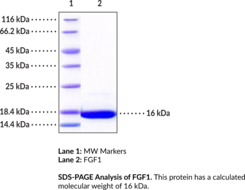
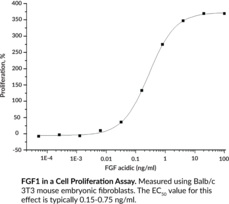
Fibroblast growth factor 1 (FGF1), also known as acidic FGF (AFGF), is a signaling polypeptide and member of the FGF family with roles in cell growth, proliferation, development, and survival, as well as osteogenesis and adipogenesis.1,2 Unlike other FGFs, FGF1 lacks an N-terminal signaling peptide and is secreted via a non-canonical pathway as part of a multi-protein complex.1 FGF1 binds to FGF receptors at the cell surface to stimulate intracellular signaling pathways such as PKC/PLCγ, PI3K/Akt/mTOR, and ERK/MAPK, but can also be translocated across the cell membrane to localize in both the cytosol and nucleus. FGF1 induces osteogenic differentiation of bone marrow mesenchymal stem cells and increases the number of osteoblasts in early stages of bone repair. Exogenous administration of FGF1 normalizes blood glucose levels in diabetic ob/ob and db/db mice and a mouse model of diet-induced obesity.3 Cayman’s FGF1 (human, recombinant) protein can be used for cell-based assays. This protein consists of 141 amino acids and has a calculated molecular weight of 16 kDa.
WARNING This product is not for human or veterinary use.
References & Product Citations
1. Intracellular partners of fibroblast growth factors 1 and 2 -
2. The role of the fibroblast growth factor family in bone-
3. FGF1 -
Contact Info
Cayman Chemical1180 East Ellsworth RoadAnn Arbor, Michigan 48108 USAToll Free: (800) 364-9897(USA and Canada only)Fax: (734) 971-3640


