
Technical Support & Resources
Visit our FAQ
Contact Us
Toll Free Phone (USA and Canada Only): (888) 526-5351
Direct Phone: (734) 975-3888
Product Categories
Application
Technical Information
- Basic Fibroblast Growth Factor Receptor 1
- bFGF-R-1
- BFGFR
- CD331
- Fibroblast Growth Factor Receptor 1
- FGFBR
- FLT2
- Fms-like Tyrosine Kinase 2
Shipping & Storage Information
Recommended Products
Certificates of Analysis & Batch Specific Data
Provide batch numbers separated by commas to download or request available product inserts, QC sheets, certificates of analysis, data packs, and GC-MS data.
Kinase Resource Center
Discover Products & Resources for Kinase Research
- Kinase inhibitors, screening libraries, assay kits, & more
- Tools to study kinase signaling pathways:
- Growth factor signaling
- PI3K/Akt/mTOR
- MAPKs (ERK, p38, & JNK)
- JAK/STAT signaling
- Articles, resources, & advice
Product Description
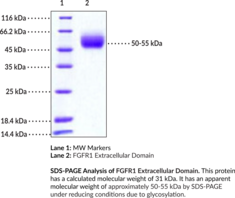
Fibroblast growth factor receptor 1 (FGFR1) is a growth factor receptor with roles in cell migration, differentiation, and survival, as well as apoptosis, chemotaxis, and embryonic development.1,2 It is composed of an N-terminal extracellular domain, which contains three immunoglobulin-like (Ig-like) domains, including the FGF ligand-binding domain, an acidic box, and a CAM-homology domain, a transmembrane domain, and a C-terminal tyrosine kinase domain. FGFR1 is expressed throughout the pre-differentiated mesenchyme of the cranium, in midfacial mesenchyme, and the endochondral skull base during early embryonic development, and broadly expressed in epithelial, osteogenic, and chondrogenic cell lineages by 10 to 13 weeks gestation.3 Upon ligand binding, FGFR1 dimerizes, resulting in autophosphorylation of the tyrosine kinase domain and activation of various intracellular signaling pathways, including the ERK/MAPK pathway.1 Mutations in FGFR1 induce various craniofacial dysostosis syndromes, such as Crouzon, Pfeiffer, and Jackson-Weiss syndromes that feature basicranial and midfacial deformities.3 FGFR1 amplifications, translocations, and fusions are associated with lung cancer, 8p11 myeloproliferative syndrome, and glioblastoma multiforme, respectively.4 Cayman’s FGFR1 Extracellular Domain (human, recombinant) can be used for enzyme activity assays. This protein consists of 275 amino acids, has a calculated molecular weight of 31 kDa, and a predicted N-terminus of Arg22 after signal peptide cleavage. By SDS-PAGE, under reducing conditions, the apparent molecular mass of the protein is 50-55 kDa due to glycosylation.
WARNING This product is not for human or veterinary use.
References & Product Citations
1. Fibroblast growth factor signaling during early vertebrate development. Endocr. Rev. 26(1), 63-77 (2005).
2. FGFR1 mutations in Kallmann syndrome. Front. Horm. Res. 39, 51-61 (2010).
3. From genotype to phenotype: The differential expression of FGF, FGFR, and TGFβ genes characterizes human cranioskeletal development and reflects clinical presentation in FGFR syndromes. Plast. Reconstr. Surg. 108(7), 2026-2039 (2001).
4. FGF receptors: Cancer biology and therapeutics. Med. Res. Rev. 34(2), 280-300 (2014).
Contact Info
Cayman Chemical1180 East Ellsworth RoadAnn Arbor, Michigan 48108 USAToll Free: (800) 364-9897(USA and Canada only)Fax: (734) 971-3640


