
Technical Support & Resources
Visit our FAQ
Contact Us
Toll Free Phone (USA and Canada Only): (888) 526-5351
Direct Phone: (734) 975-3888
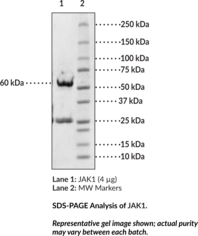
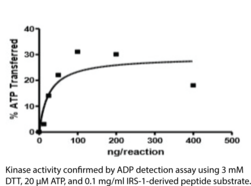
Technical Information
- Janus-Associated Kinase 1
- JTK3
- Tyrosine-Protein Kinase JAK1
Shipping & Storage Information
Recommended Products
Certificates of Analysis & Batch Specific Data
Provide batch numbers separated by commas to download or request available product inserts, QC sheets, certificates of analysis, data packs, and GC-MS data.
Kinase Resource Center
Discover Products & Resources for Kinase Research
- Kinase inhibitors, screening libraries, assay kits, & more
- Tools to study kinase signaling pathways:
- Growth factor signaling
- PI3K/Akt/mTOR
- MAPKs (ERK, p38, & JNK)
- JAK/STAT signaling
- Articles, resources, & advice
Product Description
JAK1 is a non-receptor tyrosine kinase that has roles in immune signaling.1,2,3 It is composed of N-terminal FERM and SH2 domains, a regulatory pseudokinase domain, and a C-terminal kinase domain.2 It is widely expressed and associates with class I and class II cytokine receptors at the plasma membrane.3 Activation of these cytokine receptors activates JAK1 and induces its dimerization and kinase activity, leading to JAK1 phosphorylation of STAT transcription factors and transcription of immune-related target genes.2,4 JAK1 signaling is inhibited by the suppressor of cytokine signaling (SOCS) proteins SOCS-1, SOCS-3, and SOCS-5.5,6 Knockout of Jak1 in mice results in perinatal mortality and deficits in lymphopoiesis.7 JAK1 fusion proteins and activating mutations in JAK1 are associated with acute myeloid leukemia (AML) and T cell precursor acute lymphoblastic leukemia (ALL).8 Cayman’s JAK1 (human, recombinant) protein can be used for enzyme activity assays.
WARNING This product is not for human or veterinary use.
References & Product Citations
1. The structural basis for class II cytokine receptor recognition by JAK1. Structure 24(6), 897-905 (2016).
2. Jaks and STATs: Biological implications. Annu. Rev. Immunol. 16, 293-322 (1998).
3. Jaks and cytokine receptors—an intimate relationship. Biochem. Pharmacol. 72(11), 1538-1546 (2006).
4. The Jak-
5. The suppressors of cytokine signalling (SOCS). Cell. Mol. Life Sci. 58(11), 1627-1635 (2001).
6. Suppressor of cytokine signaling (SOCS) 5 utilises distinct domains for regulation of JAK1 and interaction with the adaptor protein Shc-
7. Disruption of the Jak1 gene demonstrates obligatory and nonredundant roles of the Jaks in cytokine-
8. JAKs in pathology: Role of Janus kinases in hematopoietic malignancies and immunodeficiencies. Semin. Cell Dev. Biol. 19(4), 385-393 (2008).
Contact Info
Cayman Chemical1180 East Ellsworth RoadAnn Arbor, Michigan 48108 USAToll Free: (800) 364-9897(USA and Canada only)Fax: (734) 971-3640


