
Technical Support & Resources
Information provided in the product description is from published literature. Due to the nature of scientific experimentation, your results (e.g., selectivity and effective concentrations) or specific application for this product may differ. If you have questions about how this product fits your application, please contact our technical support staff.
Visit our FAQ
Contact Us
Toll Free Phone (USA and Canada Only): (888) 526-5351
Direct Phone: (734) 975-3888
Product Categories

Technical Information
- NSC 5302
Shipping & Storage Information
Recommended Products
Certificates of Analysis & Batch Specific Data
Provide batch numbers separated by commas to download or request available product inserts, QC sheets, certificates of analysis, data packs, and GC-MS data.
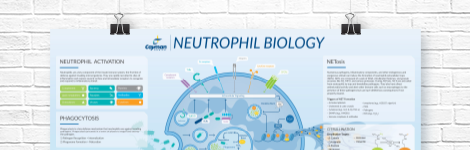
Neutrophil Biology Wall Poster
Explore how neutrophils shape the immune response in health and disease. This poster highlights neutrophil pathogen defense mechanisms, including phagocytosis, degranulation, and NETosis, as well as neutrophil roles in inflammation and NET-associated pathologies.
DOWNLOAD NOWProduct Description
5,7-Dihydroxy-4-methylcoumarin is a synthetic coumarin with diverse biological activities.1,2,3,4,5,6,7 It scavenges alkylperoxy radicals and hypochlorous acid (HOCl; IC50 = 2.85 µM) in cell-free assays, as well as inhibits lipid peroxidation in rat liver microsomes, A23187-induced thromboxane B2 (TXB2; Item No. 19030) generation in isolated rat peritoneal leukocytes, and myeloperoxidase (MPO) activity in a cell-free assay (IC50s = 12, 1, and 1.06 µM, respectively).1,2 5,7-Dihydroxy-4-methylcoumarin also inhibits rat lens aldose reductase (IC50 = 17 µM) and human carbonic anhydrase I (CAI), CAIX, and CAXII with Ki values of 8.4, 0.19, and 6.4 µM, respectively.3,4 It inhibits platelet aggregation induced by arachidonic acid (Item Nos. 90010 | 90010.1 | 10006607) with an IC50 value of 45 µM.6 5,7-Dihydroxy-4-methylcoumarin inhibits hepatitis C virus (HCV) non-structural protein 5B (NS5B) polymerase (IC50 = 47.2 µM).5 It is active against H. pylori with an MIC value of 10 µg/ml.7
WARNING This product is not for human or veterinary use.
References & Product Citations
1. Pharmacological and biochemical actions of simple coumarins: Natural products with therapeutic potential. Gen. Pharmacol. 27(4), 713-722 (1996).
2. 4-
3. Synthesis and rat lens aldose reductase inhibitory activity of some benzopyran-
4. Novel coumarins and benzocoumarins acting as isoform-
5. Evaluation of coumarin and neoflavone derivatives as HCV NS5B polymerase inhibitors. Chem. Biol. Drug Des. 81(5), 607-614 (2013).
6. In vitro platelet antiaggregatory properties of 4-
7. Inhibition of growth of Helicobacter pylori and its urease by coumarin derivatives: Molecular docking analysis. J. Pharm. Res. 7(8), 705-711 (2013).
Contact Info
Cayman Chemical1180 East Ellsworth RoadAnn Arbor, Michigan 48108 USAToll Free: (800) 364-9897(USA and Canada only)Fax: (734) 971-3640


