
Technical Support & Resources
Visit our FAQ
Contact Us
Toll Free Phone (USA and Canada Only): (888) 526-5351
Direct Phone: (734) 975-3888
IGF-1R/CD221 Extracellular Domain (human, recombinant)
Item No. 33982
Technical Information
- CD221
- IGF-I Receptor
- Insulin-like Growth Factor Receptor α- and β-chains
Shipping & Storage Information
Recommended Products
Certificates of Analysis & Batch Specific Data
Provide batch numbers separated by commas to download or request available product inserts, QC sheets, certificates of analysis, data packs, and GC-MS data.
Kinase Resource Center
Discover Products & Resources for Kinase Research
- Kinase inhibitors, screening libraries, assay kits, & more
- Tools to study kinase signaling pathways:
- Growth factor signaling
- PI3K/Akt/mTOR
- MAPKs (ERK, p38, & JNK)
- JAK/STAT signaling
- Articles, resources, & advice
Product Description
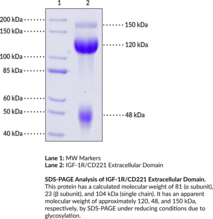
Insulin-like growth factor 1 receptor (IGF-1R), also known as CD221, is a member of the type II receptor tyrosine kinase family, previously known as the insulin receptor family.1 It is synthesized as a preproreceptor with a signal peptide that is cleaved by a furin protease to produce an α- and a β-chain.2 The mature protein forms homodimers, which are composed of two extracellular α-chain subunits that comprise the ligand-binding domain, a transmembrane domain, and two intracellular β-chain subunits that contain a tyrosine kinase domain and a C-terminal tail containing several phosphorylation sites located in two interactor domains, which are separated by a regulatory domain.1,3 It is ubiquitously expressed and, when activated by its ligand IGF-1, IGF-1R undergoes autophosphorylation then phosphorylates and activates intracellular proteins, including insulin receptor substrate (IRS) proteins, activating downstream signaling via the PI3K/Akt, Rac, and RAS/RAF/MEK/ERK pathways.1 Through these signaling pathways, IGF-1R is involved in inhibition of apoptosis and the regulation of cell migration and proliferation. Overexpression or mutation of CD221 is associated with a variety of cancers, and SNPs in CD221 are positively correlated with an increased risk of cancer.4 IGF-1R protein levels are increased in neurons of the temporal cortex in postmortem brain tissue from patients with Alzheimer’s disease, as well as around and within amyloid-β plaques.5 Increased levels of IGF-1R have been found in orbital fibroblasts, B cells, and T cells from patients with Graves' disease.6 Formulations containing anti-IGF-1R antibodies have been used in the treatment of Graves' orbitopathy. Cayman's IGF-1R/CD221 Extracellular Domain (human, recombinant) protein can be used for binding assays. This protein has calculated molecular weights of 81, 23, and 104 kDa for the α subunit, β subunit, and single chain of the receptor, respectively, and a predicted N-terminus of Glu31 after signal peptide cleavage. By SDS-PAGE, under reducing conditions, the apparent molecular masses are 120, 48, and 150 kDa, respectively, due to glycosylation.
WARNING This product is not for human or veterinary use.
References & Product Citations
1. Expression, regulation, and function of IGF-
2. Structure and function of the type 1 insulin-
3. The tale of a tail: The secret behind IGF-
4. Drugging IGF-
5. Defects in IGF-
6. Role of IGF-
Contact Info
Cayman Chemical1180 East Ellsworth RoadAnn Arbor, Michigan 48108 USAToll Free: (800) 364-9897(USA and Canada only)Fax: (734) 971-3640


