
Technical Support & Resources
Visit our FAQ
Contact Us
Toll Free Phone (USA and Canada Only): (888) 526-5351
Direct Phone: (734) 975-3888
Product Categories
Application
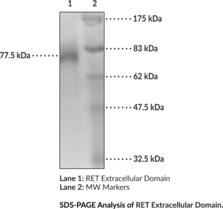
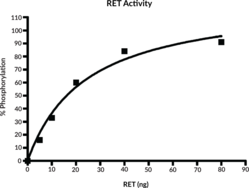
Technical Information
- Cadherin Family Member 12
- Cadherin-related Family Member 16
- CDHF12
- CDHR16
- Hydroxyaryl-protein Kinase
- MEN2A
- Proto-oncogene c-Ret
- Rearranged during transfection
- RET51
Shipping & Storage Information
Certificates of Analysis & Batch Specific Data
Provide batch numbers separated by commas to download or request available product inserts, QC sheets, certificates of analysis, data packs, and GC-MS data.
Kinase Resource Center
Discover Products & Resources for Kinase Research
- Kinase inhibitors, screening libraries, assay kits, & more
- Tools to study kinase signaling pathways:
- Growth factor signaling
- PI3K/Akt/mTOR
- MAPKs (ERK, p38, & JNK)
- JAK/STAT signaling
- Articles, resources, & advice
Product Description
Rearranged during transfection (RET) is a receptor tyrosine kinase with roles in cell proliferation, survival, metabolism, and migration, as well as in the development of the peripheral and central nervous systems.1,2 It is composed of an extracellular domain, containing four cadherin-like domains (CLDs), a calcium-binding site, and a cysteine-rich region, a transmembrane domain, and an intracellular kinase domain.1,3 RET forms heterodimeric complexes with the glial cell line-derived neurotrophic factor (GDNF) ligands GDNF, neurturin (NRTN), artemin (ARTN), and persephin (PSPN), and the GDNF family co-receptors GFRα1-4, which induces autophosphorylation of the intracellular kinase domain and activates cellular signaling.3 Germline nonsense and/or missense mutations in RET decrease functional RET in gut tissue during development and are associated with Hirschsprung’s disease.1,3 Loss-of-function mutations in RET are associated with congenital anomalies of the kidney and urinary tract (CAKUT) and renal agenesis.3 Gain-of-function mutations in RET are associated with medullary thyroid cancer, pheochromocytoma, and parathyroid hypoplasias, and RET gene fusions have been found in patients with lung, colon, or breast carcinomas.2,3 Cayman’s RET Extracellular Domain (human, recombinant) protein can be used for enzyme activity assays.
WARNING This product is not for human or veterinary use.
References & Product Citations
1. RET receptor tyrosine kinase: Role in neurodegeneration, obesity, and cancer. Int. J. Mol. Sci. 21(19), 7108 (2020).
2. RET gene fusions in malignancies of the thyroid and other tissues. Genes (Basel) 11(4), 424 (2020).
3. RET fusions in solid tumors. Cancer Treat. Rev. 81, 101911 (2019).
Contact Info
Cayman Chemical1180 East Ellsworth RoadAnn Arbor, Michigan 48108 USAToll Free: (800) 364-9897(USA and Canada only)Fax: (734) 971-3640


