
Technical Support & Resources
Visit our FAQ
Contact Us
Toll Free Phone (USA and Canada Only): (888) 526-5351
Direct Phone: (734) 975-3888
Product Categories
Product Type
Technical Information
- Angiopoietin-1 Receptor
- Endothelial Tyrosine Kinase
- Tunica Interna Endothelial Cell Kinase 2
- Tyrosine-Protein Kinase Receptor TEK
Shipping & Storage Information
Recommended Products
Certificates of Analysis & Batch Specific Data
Provide batch numbers separated by commas to download or request available product inserts, QC sheets, certificates of analysis, data packs, and GC-MS data.
Kinase Resource Center
Discover Products & Resources for Kinase Research
- Kinase inhibitors, screening libraries, assay kits, & more
- Tools to study kinase signaling pathways:
- Growth factor signaling
- PI3K/Akt/mTOR
- MAPKs (ERK, p38, & JNK)
- JAK/STAT signaling
- Articles, resources, & advice
Product Description
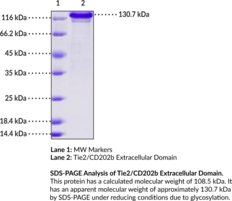
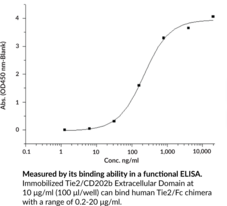
Tunica interna endothelial cell kinase 2 (Tie2), also known as CD202b, is a receptor tyrosine kinase that is encoded by the TEK gene in humans.1,2 It is composed of an extracellular ligand-binding domain containing immunoglobulin, EGF-like, and fibronectin-like repeats, a transmembrane domain, and an intracellular tyrosine kinase domain.1 Tie2 is expressed in embryonic and adult endothelial cells, as well as hematopoietic stem cells (HSCs), where it is bound by the growth factors angiopoietin-1, -2, and -4. Upon ligand binding, Tie2 forms homodimers or heterodimers with Tie1, resulting in Tie2 phosphorylation and activation of various signaling pathways, including the PI3K pathway, to promote angiogenesis, endothelial cell survival, and hematopoiesis.1,3 TEK knockout in mice is embryonic lethal with embryos lacking cardiovascular system development and exhibiting vascular hemorrhaging.1 Tie2 is upregulated in the vascular endothelium of several cancers, including lung, breast, and prostate cancers, and somatic mutations in TEK result in the development of blue rubber bleb nevus syndrome, a disease characterized by venous malformations and gastrointestinal lesions.1,2 Cayman's Tie2/CD202b Extracellular Domain (human, recombinant) protein can be used for ELISA and Western blot (WB) applications. This protein is a disulfide-linked homodimer. The reduced monomer, composed of Tie2 (amino acids 23-745) fused to His-tagged human IgG1 Fc at its C-terminus, consists of 970 amino acids, has a calculated molecular weight of 108.5 kDa, and a predicted N-terminus of Ala23 after signal peptide cleavage. As a result of glycosylation, the monomer migrates at approximately 130.7 kDa by SDS-PAGE under reducing conditions.
WARNING This product is not for human or veterinary use.
References & Product Citations
1. Tie2: A journey from normal angiogenesis to cancer and beyond. Histol. Histopathol. 23(6), 773-780 (2008).
2. Blue rubber bleb nevus (BRBN) syndrome is caused by somatic TEK (TIE2) mutations. J. Invest. Dermatol. 137(1), 207-216 (2017).
3. Structural basis of Tie2 activation and Tie2/Tie1 heterodimerization. Proc. Natl. Acad. Sci. USA 114(17), 4376-4381 (2017).
Contact Info
Cayman Chemical1180 East Ellsworth RoadAnn Arbor, Michigan 48108 USAToll Free: (800) 364-9897(USA and Canada only)Fax: (734) 971-3640


