
Technical Support & Resources
Visit our FAQ
Contact Us
Toll Free Phone (USA and Canada Only): (888) 526-5351
Direct Phone: (734) 975-3888
Product Categories
Research Area
Technical Information
- p120-PI3K
- Phosphatidylinositol 4,5-bisphosphate 3-kinase Catalytic Subunit γ isoform
- PI3K-γ
- PI3-kinase Subunit γ
Shipping & Storage Information
Recommended Products
Certificates of Analysis & Batch Specific Data
Provide batch numbers separated by commas to download or request available product inserts, QC sheets, certificates of analysis, data packs, and GC-MS data.
Kinase Resource Center
Discover Products & Resources for Kinase Research
- Kinase inhibitors, screening libraries, assay kits, & more
- Tools to study kinase signaling pathways:
- Growth factor signaling
- PI3K/Akt/mTOR
- MAPKs (ERK, p38, & JNK)
- JAK/STAT signaling
- Articles, resources, & advice
Product Description
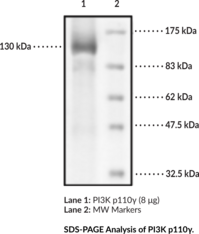
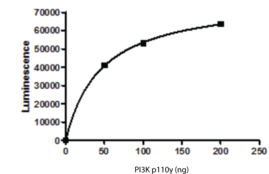
Class I phosphatidylinositol 3-kinases (PI3Ks) are membrane-associated lipid kinases with roles in membrane trafficking during autophagy, endosome recycling, and endocytosis, adaptive and innate immune cell activation, and leukocyte chemotaxis, as well as various diseases.1,2,3 They are heterodimeric enzymes composed of a p110 catalytic subunit and a regulatory subunit and act on three substrates, non-phosphorylated phosphatidylinositol (PI), inositol monophosphate (PI(4)P), and inositol bisphosphate (PI(4,5)P2), to generate PI(3)P, PI(3,4)P2, and PI(3,4,5)P3, respectively.1,2 The PI3K catalytic isoform p110γ forms a complex with the regulatory subunits p101 or p87, also known as p84, and is selectively controlled by G protein-coupled receptors to regulate signaling.1 It is widely expressed, with high levels in cells of immune and hematopoietic origin, and dysregulation of p110γ expression is associated with tumorigenesis and invasion in various solid tumors. The gene encoding PI3K p110γ, PIK3CG, is located within the autism susceptibility locus, and SNPs in PIK3CG have been found in patients with the autism spectrum disorder tuberous sclerosis.4 Inhibition of PI3K p110γ with small molecule inhibitors reduces joint inflammation and destruction in mouse models of rheumatoid arthritis, as well as reduces migration and accumulation of eosinophils in a mouse model of allergic pleurisy.3 Cayman’s PI3K p110γ (human, recombinant) protein can be used for binding assays.
WARNING This product is not for human or veterinary use.
References & Product Citations
1. Function, regulation and biological roles of PI3Kγ variants. Biomolecules 9(9), 427 (2019).
2. Phosphatidylinositol 3-
3. Taking PI3Kδ and PI3Kγ one step ahead: Dual active PI3Kδ/γ inhibitors for the treatment of immune-
4. Neuron-
Contact Info
Cayman Chemical1180 East Ellsworth RoadAnn Arbor, Michigan 48108 USAToll Free: (800) 364-9897(USA and Canada only)Fax: (734) 971-3640


