
Technical Support & Resources
Visit our FAQ
Contact Us
Toll Free Phone (USA and Canada Only): (888) 526-5351
Direct Phone: (734) 975-3888
Product Categories
Product Type
Application

Technical Information
- EPOR
Shipping & Storage Information
Recommended Products
Certificates of Analysis & Batch Specific Data
Provide batch numbers separated by commas to download or request available product inserts, QC sheets, certificates of analysis, data packs, and GC-MS data.

Kinase Resource Center
Discover Products & Resources for Kinase Research
- Kinase inhibitors, screening libraries, assay kits, & more
- Tools to study kinase signaling pathways:
- Growth factor signaling
- PI3K/Akt/mTOR
- MAPKs (ERK, p38, & JNK)
- JAK/STAT signaling
- Articles, resources, & advice
Product Description
This assay utilizes proprietary human cells that provide constitutive expression of the Human Erythropoietin Receptor (EPOR).
EPOR is a member of the class I cytokine receptor superfamily. Erythropoietin (EPO), the physiological activator of EPOR, is a glycoprotein that regulates erythropoiesis. EPO, produced by the adult kidneys, activates the cell-surface EPOR to initiate signal transduction through JAK2/STAT5, and other pathways including AKT and ERK1/2. The activation of these various pathways may culminate in the activation of cytosolic targets, or in the activation of specific transcription factors and the induction of their specific target genes.
JAK2 dependent phosphorylation and activation of the transcription factor STAT5 is a prominent outcome of EPOR activation, and it is the signaling pathway exploited by the reporter cells in this assay kit. Specifically, INDIGO's Reporter Cells contain the luciferase gene functionally linked to an engineered minimal promoter sequence with upstream tandem STAT5 genetic response element (GRE) sequences. Erythropoietin activates EPOR in a dose-dependent manner, thereby triggering the JAK2/STAT signal transduction cascade. Activated STAT5 binds to its consensus GREs to initiate the formation of a complete transcription complex that drives expression of the Luc reporter gene. Therefore, quantifying changes in luciferase activity from peptide-, drug-, or antibody-treated reporter cells relative to that of 'untreated' cells provides a sensitive, dose-dependent surrogate measure of changes in the activity of EPOR.
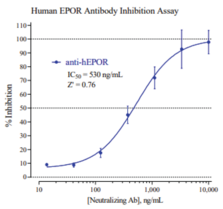
The clinical use of recombinant human EPO has led to the successful treatment of anemia associated with conditions ranging from chronic kidney disease, chemotherapy treatment for cancer, and surgery-associated blood loss. However, side effects including hypertension, increased risk for stroke, venous thromboembolism, and death, are also risks for patients treated with hEPO and other biosimilars. This provides an opportunity for the development of additional erythropoiesis stimulating agents (ESAs) which lack these adverse effects. Additionally, though erythroid progenitor cells express the highest levels of EPOR, it is also expressed on non-erythroid cells, including neural cells, myoblasts, and adipocytes, indicative of important of physiological functions of EPO outside its essential role in erythropoiesis. Accordingly, the primary application of this reporter assay is to screen test materials for any functional activity, either agonistic or inhibitory, that they may exert against the human EPOR.
Reporter cells are prepared using INDIGO’s proprietary CryoMite™ process. This cryo-preservation method yields high cell viability post-thaw, and provides the convenience of immediately dispensing healthy, division-competent reporter cells into assay plates. There is no need for intermediate spin-and-wash steps, viability determinations, or cell titer adjustments. [INDIGO Catalog Nos. IB17001, IB17001-32, IB17002]
WARNING This product is not for human or veterinary use.
Contact Info
Cayman Chemical1180 East Ellsworth RoadAnn Arbor, Michigan 48108 USAToll Free: (800) 364-9897(USA and Canada only)Fax: (734) 971-3640


