
Technical Support & Resources
Visit our FAQ
Contact Us
Toll Free Phone (USA and Canada Only): (888) 526-5351
Direct Phone: (734) 975-3888
Technical Information
- Calmodulin-dependent Calcineurin A Subunit α Isoform
- CALNA1
- CAM-PRP Catalytic Subunit
- CCN1
- CNA1
- PPP2B
- PPP3CA
- Protein Phosphatase 2B
- Serine/threonine-Protein Phosphatase 2B Catalytic Subunit α Isoform
Shipping & Storage Information
Recommended Products
Certificates of Analysis & Batch Specific Data
Provide batch numbers separated by commas to download or request available product inserts, QC sheets, certificates of analysis, data packs, and GC-MS data.
Product Description
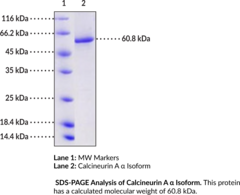
Calcineurin A is the catalytic subunit of calcineurin, a serine/threonine phosphatase with roles in T cell activation, cardiac function, learning and memory, apoptosis, and cell cycle regulation.1,2 Calcineurin A has three isoforms, α, β, and γ, which are encoded by PPP3CA, PPP3CB, and PPP3CC, respectively. Calcineurin A α is composed of an N-terminal catalytical domain, binding regions for the regulatory subunit calcineurin B (Item No. 34631) and the binding partner calmodulin, and a C-terminal autoinhibitory domain.3,4 It is ubiquitously expressed and associates with calcineurin B and calmodulin in a calcium-dependent manner.5,6 Calcineurin A α has roles in kidney development and function, as well as Tau dephosphorylation, but is dispensable for T cell development.6 Calcineurin A α-null mice exhibit impaired kidney function, failure to thrive, and shortened lifespan. Brain calcineurin A α levels are inversely correlated with disease severity in patients with Alzheimer's disease.7 Cayman's Calcineurin A α Isoform (human, recombinant) protein can be used for binding assays. This protein consists of 538 amino acids and has a calculated molecular weight of 60.8 kDa.
WARNING This product is not for human or veterinary use.
References & Product Citations
1. Calcineurin: Form and function. Physiol. Rev. 80(4), 1483-1521 (2020).
2. Calcineurin. xPharm: The Comprehensive Pharmacology Reference (2007).
3. An emerging role for calcineurin Aα in the development and function of the kidney. Am. J. Physiol. Renal. Physiol. 290(4), F769-F776 (2006).
4. Interaction of calcineurin with substrates and targeting proteins. Trends Cell Biol. 21(2), 91-103 (2011).
5. Calcineurin (PPP3CB) regulates angiotensin II-
6. Calcineurin inhibitors and immunosuppression -
7. Calcium phosphatase calcineurin influences tau metabolism. Neurobiol. Aging 34(2), 374-386 (2013).
Contact Info
Cayman Chemical1180 East Ellsworth RoadAnn Arbor, Michigan 48108 USAToll Free: (800) 364-9897(USA and Canada only)Fax: (734) 971-3640


