
Technical Support & Resources
Information provided in the product description is from published literature. Due to the nature of scientific experimentation, your results (e.g., selectivity and effective concentrations) or specific application for this product may differ. If you have questions about how this product fits your application, please contact our technical support staff.
Visit our FAQ
Contact Us
Toll Free Phone (USA and Canada Only): (888) 526-5351
Direct Phone: (734) 975-3888
Product Categories
Technical Information
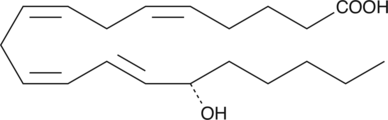
- 15(S)-Hydroxyeicosatetraenoic Acid
Shipping & Storage Information
Recommended Products
Certificates of Analysis & Batch Specific Data
Provide batch numbers separated by commas to download or request available product inserts, QC sheets, certificates of analysis, data packs, and GC-MS data.
Lipid Resource Center
Discover Products & Resources for Lipid Research
- High-purity lipid standards
- Lipid roles in biology
- Lipids in health & disease
- Lipids for pharmaceutical development
- Protocols, advice, & resources
Product Description
15(S)-HETE is an active metabolite of arachidonic acid (Item Nos. 90010 | 90010.1 | 10006607).1 It is formed via oxidation of arachidonic acid by 15-lipoxygenase 2 (15-LO-2) in macrophages, as well as the prostate, lung, and skin, but also by 15-LO-1 in airway epithelial cells, eosinophils, and reticulocytes.2,3 15(S)-HETE inhibits the proliferation of HT-29 colorectal and PC3 prostate cancer cells (IC50s = 40 and 30 µM, respectively).4,5 It increases kruppel-like factor 10 (KLF10) and decreases B cell lymphoma 2 (Bcl-2) protein levels in HT-29 cells when used at a concentration of 40 µM.4 15(S)-HETE (0.1 µM) increases HMG-CoA reductase protein levels in human dermal microvascular endothelial cells (HDMVECs).6 It increases Rac1 protein levels and induces farnesylation of Rac1 in HDMVECs when used at a concentration of 0.1 µM.
WARNING This product is not for human or veterinary use.
References & Product Citations
1. Immunocytochemical localization of arachidonate 15-
2. 15-
3. Biosynthesis, biological effects, and receptors of hydroxyeicosatetraenoic acids (HETEs) and oxoeicosatetraenoic acids (oxo-
4. 15-
5. 15S-
6. 12/15-
On the biosynthesis of specialized pro-
Phospholipase iPLA2β averts ferroptosis by eliminating a redox lipid death signal. Nat. Chem. Biol. (2021).
Suppression of membranous LRP5 recyling, Wnt/β-
Determination of ω-
Quantitative assays for esterified oxylipins generated by immune cells. Nat. Protoc. 5(12), 1919-1931 (2010).
Plasma cross-
Structural and functional basis of phospholipid oxygenase activity of bacterial lipoxygenase from Pseudomonas aeruginosa. Biochim. Biophys. Acta 1861, 1681-1692 (2016).
Nature of the cardiomyocyte injury induced by lipid hydroperoxides. Cardiovasc. Res. 30, 648-655 (1995).
Chemoprevention of colon carcinogenesis by phenylethyl-
Contact Info
Cayman Chemical1180 East Ellsworth RoadAnn Arbor, Michigan 48108 USAToll Free: (800) 364-9897(USA and Canada only)Fax: (734) 971-3640


