
Technical Support & Resources
Visit our FAQ
Contact Us
Toll Free Phone (USA and Canada Only): (888) 526-5351
Direct Phone: (734) 975-3888
Product Categories
Application

Technical Information
Shipping & Storage Information
Recommended Products
Certificates of Analysis & Batch Specific Data
Provide batch numbers separated by commas to download or request available product inserts, QC sheets, certificates of analysis, data packs, and GC-MS data.
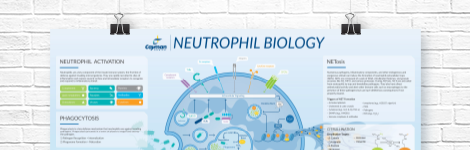
Neutrophil Biology Wall Poster
Explore how neutrophils shape the immune response in health and disease. This poster highlights neutrophil pathogen defense mechanisms, including phagocytosis, degranulation, and NETosis, as well as neutrophil roles in inflammation and NET-associated pathologies.
DOWNLOAD NOWProduct Description
L-Lysine-d3 is intended for use as an internal standard for the quantification of L-lysine by GC- or LC-MS. L-Lysine is an essential amino acid.1 It is catabolized via the saccharopine pathway to produce acetyl-coenzyme A (acetyl-CoA; Item No. 16160) in liver mitochondria. L-Lysine is also a precursor in the biosynthesis of L-carnitine (Item No. 21489), a conditionally essential nutrient that has roles in energy production and fatty acid metabolism.2 L-Lysine (400 mg/kg per day) reduces viral shedding in cats latently infected with feline herpesvirus type 1 (FHV-1).3 Administration of an L-lysine-deficient diet increases fecal pellet excretion induced by restraint stress, indicating increases in anxiety, in rats.4 Formulations containing L-lysine have been used as dietary supplements.
WARNING This product is not for human or veterinary use.
References & Product Citations
1. Saccharopine, a lysine degradation intermediate, is a mitochondrial toxin. J. Cell Biol. 218(2), 391-392 (2019).
2. Role of carnitine in disease. Nutr. Metab. 7(30), (2010).
3. Efficacy of oral supplementation with L-
4. Dietary L-
Contact Info
Cayman Chemical1180 East Ellsworth RoadAnn Arbor, Michigan 48108 USAToll Free: (800) 364-9897(USA and Canada only)Fax: (734) 971-3640


