
A peptide fragment of Nogo-A
Technical Support & Resources

Information provided in the product description is from published literature. Due to the nature of scientific experimentation, your results (e.g., selectivity and effective concentrations) or specific application for this product may differ. If you have questions about how this product fits your application, please contact our technical support staff.

Visit our FAQ

Contact Us

Toll Free Phone (USA and Canada Only): (888) 526-5351
Direct Phone: (734) 975-3888

Request Technical Support

Technical Support Request

To streamline the process attach the appropriate questionnaire to your inquiry.

Download IHC QuestionnaireDownload WB Questionnaire

View Our Privacy Statement for details on how we use and protect your data. In addition, this site is protected by hCaptcha and its Privacy Policy and Terms of Service apply.

Nogo-66 (1-40) (human, mouse, rat) (trifluoroacetate salt)

Item No. 35310
Technical Information
Formal Name
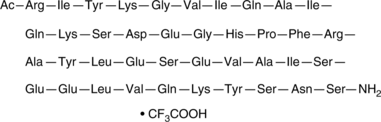
N2-acetyl-L-arginyl-L-isoleucyl-L-tyrosyl-L-lysylglycyl-L-valyl-L-isoleucyl-L-glutaminyl-L-alanyl-L-isoleucyl-L-glutaminyl-L-lysyl-L-seryl-L-α-aspartyl-L-α-glutamylglycyl-L-histidyl-L-prolyl-L-phenylalanyl-L-arginyl-L-alanyl-L-tyrosyl-L-leucyl-L-α-glutamyl-L-seryl-L-α-glutamyl-L-valyl-L-alanyl-L-isoleucyl-L-seryl-L-α-glutamyl-L-α-glutamyl-L-leucyl-L-valyl-L-glutaminyl-L-lysyl-L-tyrosyl-L-seryl-L-asparaginyl-L-serinamide, monotrifluoroacetate salt
Synonyms
  • NEP1-40
  • Nogo-40
  • Nogo-A Inhibitory Peptide
  • RIYKGVIQAIQKSDEGHPFRAYLESEVAISEELVQKYSNS-NH2
Molecular Formula
C206H324N56O65 • CF3COOH
Formula Weight
Purity
≥95%
A solid
SMILES
OC(C[C@H](NC([C@H](CO)NC([C@H](CCCCN)NC([C@H](CCC(N)=O)NC([C@](NC([C@@H](NC([C@H](CCC(N)=O)NC([C@](NC([C@H](C(C)C)NC(CNC([C@H](CCCCN)NC([C@H](CC(C=C1)=CC=C1O)NC([C@](NC([C@H](CCCNC(N)=N)NC(C)=O)=O)([H])[C@H](CC)C)=O)=O)=O)=O)=O)([H])[C@H](CC)C)=O)=O)C)=O)([H])[C@H](CC)C)=O)=O)=O)=O)C(N[C@@H](CCC(O)=O)C(NCC(N[C@@H](CC2=CNC=N2)C(N3CCC[C@H]3C(N[C@H](C(N[C@@H](CCCNC(N)=N)C(N[C@H](C(N[C@@H](CC(C=C4)=CC=C4O)C(N[C@H](C(N[C@@H](CCC(O)=O)C(N[C@@H](CO)C(N[C@@H](CCC(O)=O)C(N[C@@H](C(C)C)C(N[C@H](C(N[C@@](C(N[C@@H](CO)C(N[C@@H](CCC(O)=O)C(N[C@@H](CCC(O)=O)C(N[C@H](C(N[C@@H](C(C)C)C(N[C@@H](CCC(N)=O)C(N[C@@H](CCCCN)C(N[C@@H](CC(C=C5)=CC=C5O)C(N[C@@H](CO)C(N[C@@H](CC(N)=O)C(N[C@@H](CO)C(N)=O)=O)=O)=O)=O)=O)=O)=O)CC(C)C)=O)=O)=O)=O)([H])[C@H](CC)C)=O)C)=O)=O)=O)=O)=O)CC(C)C)=O)=O)C)=O)=O)CC6=CC=CC=C6)=O)=O)=O)=O)=O)=O.OC(C(F)(F)F)=O
InChi Code
InChI=1S/C206H324N56O65.C2HF3O2/c1-23-104(15)163(258-169(292)109(20)226-174(297)126(59-67-148(210)272)240-201(324)166(107(18)26-4)261-199(322)160(101(9)10)255-153(277)92-223-171(294)120(41-30-33-75-207)230-186(309)138(86-115-51-57-119(271)58-52-115)249-202(325)165(106(17)25-3)260-182(305)121(228-111(22)268)44-36-78-220-205(215)216)200(323)241-128(61-69-150(212)274)178(301)232-123(43-32-35-77-209)176(299)251-144(95-265)195(318)247-140(89-159(288)289)190(313)234-125(62-70-154(278)279)172(295)222-91-152(276)229-141(87-116-90-219-98-224-116)204(327)262-80-38-46-147(262)196(319)248-137(83-112-39-28-27-29-40-112)185(308)233-124(45-37-79-221-206(217)218)173(296)225-108(19)168(291)242-135(84-113-47-53-117(269)54-48-113)187(310)244-133(81-99(5)6)184(307)236-131(65-73-157(284)285)181(304)252-143(94-264)192(315)238-132(66-74-158(286)287)183(306)256-161(102(11)12)197(320)227-110(21)170(293)259-164(105(16)24-2)203(326)254-146(97-267)193(316)237-129(63-71-155(280)281)179(302)235-130(64-72-156(282)283)180(303)243-134(82-100(7)8)191(314)257-162(103(13)14)198(321)239-127(60-68-149(211)273)177(300)231-122(42-31-34-76-208)175(298)245-136(85-114-49-55-118(270)56-50-114)188(311)253-145(96-266)194(317)246-139(88-151(213)275)189(312)250-142(93-263)167(214)290;3-2(4,5)1(6)7/h27-29,39-40,47-58,90,98-110,120-147,160-166,263-267,269-271H,23-26,30-38,41-46,59-89,91-97,207-209H2,1-22H3,(H2,210,272)(H2,211,273)(H2,212,274)(H2,213,275)(H2,214,290)(H,219,224)(H,222,295)(H,223,294)(H,225,296)(H,226,297)(H,227,320)(H,228,268)(H,229,276)(H,230,309)(H,231,300)(H,232,301)(H,233,308)(H,234,313)(H,235,302)(H,236,307)(H,237,316)(H,238,315)(H,239,321)(H,240,324)(H,241,323)(H,242,291)(H,243,303)(H,244,310)(H,245,298)(H,246,317)(H,247,318)(H,248,319)(H,249,325)(H,250,312)(H,251,299)(H,252,304)(H,253,311)(H,254,326)(H,255,277)(H,256,306)(H,257,314)(H,258,292)(H,259,293)(H,260,305)(H,261,322)(H,278,279)(H,280,281)(H,282,283)(H,284,285)(H,286,287)(H,288,289)(H4,215,216,220)(H4,217,218,221);(H,6,7)/t104-,105-,10
InChi Key
KZHMYCJISUXHLJ-GMMCLIGKSA-N
Shipping & Storage Information
Storage
-20°C
Shipping
Room temperature in continental US; may vary elsewhere
Recommended Products

Certificates of Analysis & Batch Specific Data

Provide batch numbers separated by commas to download or request available product inserts, QC sheets, certificates of analysis, data packs, and GC-MS data.

    Add

    Add

    Add

    Add

    Product Description

    Nogo-66 (1-40) is a peptide fragment of Nogo-A that corresponds to the extracellular domain, Nogo-66, which can induce neurite growth cone collapse in oligodendrocytes.1,2 It is also an antagonist of the Nogo-66 receptor (NgR).2 It inhibits binding of the NgR agonist AP-Nogo-66 to, and inhibits growth cone collapse induced by the NgR agonist GST-Nogo-66 in, embryonic day 12 (E12) chick dorsal root ganglia (DRG) explants.2 Nogo-66 (1-40) partially reverses axonal outgrowth inhibition induced by purified CNS myelin in E12 chick DRG explants (EC50 = 50 nM). It also induces regeneration of corticospinal tract fibers and improves locomotor function in a rat model of midthoracic spinal cord hemisection injury when administered intrathecally at a dose of 75 µg/kg per day.

    WARNING This product is not for human or veterinary use.

    References & Product Citations
    Product Description References

    1. Lim, M., Shi, J., Wei, Z., et alStructural characterization of the human Nogo-A functional domains. Solution structure of Nogo-40, a Nogo-66 receptor antagonist enhancing injured spinal cord regeneration. Eur. J. Biochem. 271(17), 3512-3522 (2004).

    2. GrandPré, T., Li, S., and Strittmatter, S.M. Nogo-66 receptor antagonist peptide promotes axonal regeneration. Nature 417(6888), 547-551 (2002).

