
Technical Support & Resources
Visit our FAQ
Contact Us
Toll Free Phone (USA and Canada Only): (888) 526-5351
Direct Phone: (734) 975-3888
Product Categories
Product Type
Research Area
Application
Technical Information
- CD62 Antigen-like Family Member E
- ELAM1
- Endothelial Leukocyte Adhesion Molecule 1
- LECAM2
- Leukocyte-endothelial Cell Adhesion Molecule 2
Shipping & Storage Information
Recommended Products
Certificates of Analysis & Batch Specific Data
Provide batch numbers separated by commas to download or request available product inserts, QC sheets, certificates of analysis, data packs, and GC-MS data.

Explore Obesity & Metabolic Disease Resources
Discover high-quality research tools to investigate GLP-1 mechanisms and next-generation metabolic targets.
OBESITY RESEARCH SOLUTIONSProduct Description
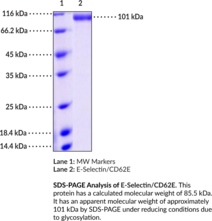
E-Selectin, also known as CD62E, is a glycoprotein encoded by the SELE gene in humans that has roles as a cellular adhesion molecule.1,2 It is composed of an N-terminal C-type lectin-like domain, which recognizes carbohydrate ligands, an EGF-like domain, multiple short consensus repeats (SCRs), a transmembrane region, and a C-terminal cytoplasmic tail.2,3 E-Selectin is constitutively expressed in bone marrow endothelial cells, where it has a role in maintaining the stem cell niche, and its expression is induced in vascular endothelial cells by inflammatory stimuli, such as TNF-α, IL-1β, or LPS.2,1 It also exists as a soluble form that is shed from the cell surface via proteolytic cleavage.4 E-selectin recognizes and binds to a variety of glycoproteins and glycolipids expressed by leukocytes, hematopoietic cells, or cancer cells, including L-selectin, sialyl Lewis X (sLeX), and E-selectin ligand-1 (ESL-1), as well as CD44 and CD43E.5 Binding of E-selectin to its ligands facilitates the tethering and rolling of infiltrating cells on endothelial cells and promotes their extravasation into inflamed tissues.2 Sele-/- mice exhibit reduced infiltration of metastatic cancer cells to the lung, and serum soluble E-selectin levels are elevated in patients with a variety of conditions, including atherosclerosis, type 1- and type 2 diabetes, sepsis, and multiple sclerosis.6,7,8,9 Cayman's E-Selectin/CD62E Extracellular Domain (mouse, recombinant) protein can be used for cell-based assays. This protein is a disulfide-linked homodimer. The reduced monomer, composed of E-selectin (amino acids 29-564) fused to human IgG1 Fc at its C-terminus, consists of 777 amino acids, has a calculated molecular weight of 85.5 kDa, and a predicted N-terminus of Trp29 after signal peptide cleavage. By SDS-PAGE, under reducing conditions, the apparent molecular mass of the protein is 101 kDa due to glycosylation.
WARNING This product is not for human or veterinary use.
References & Product Citations
1. E-
2. Selectins-
3. Functional binding of E-
4. Loss of endothelial surface expression of E-
5. Targeting selectins and selectin ligands in inflammation and cancer. Expert Opin. Ther. Targets 11(11), 1473-1491 (2007).
6. Endothelial focal adhesion kinase mediates cancer cell homing to discrete regions of the lungs via E-
7. Genome-
8. Soluble E-
9. Soluble E-
Contact Info
Cayman Chemical1180 East Ellsworth RoadAnn Arbor, Michigan 48108 USAToll Free: (800) 364-9897(USA and Canada only)Fax: (734) 971-3640


