
Technical Support & Resources
Visit our FAQ
Contact Us
Toll Free Phone (USA and Canada Only): (888) 526-5351
Direct Phone: (734) 975-3888
Product Categories
Technical Information
Shipping & Storage Information
Recommended Products
Certificates of Analysis & Batch Specific Data
Provide batch numbers separated by commas to download or request available product inserts, QC sheets, certificates of analysis, data packs, and GC-MS data.

Visit Our Cancer Resource Center
Find Tools & Resources to Study the Hallmarks of Cancer
- Cancer cell signaling & regulation
- Cancer metabolism
- Tumor microenvironment
Product Description
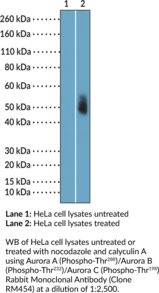
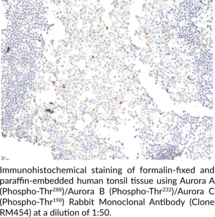
The Aurora kinases, Aurora A, -B, and -C, are a family of serine/threonine kinases encoded by distinct genes, AURKA, AURKB, and AURKC, respectively, that have roles in mitosis and meiosis.1,2 They are composed of an ATP-binding N-terminal domain, a highly conservated catalytic domain, and a short C-terminal domain that contains an activation loop and mediates cofactor binding.1 Each Aurora kinase contains a key threonine residue in its C-terminal activation loop, threonine 288 (Thr288), Thr232, and Thr198 in Aurora A, -B, and -C, respectively, that is autophosphorylated upon cofactor binding, inducing a conformational change that mediates kinase activation.1,2 Aurora A and Aurora B have roles in mitosis, whereas Aurora C regulates meiosis.2 Aurora A and Aurora B are constitutively expressed in mitotic cells, where Aurora A localizes to the spindle poles and Aurora B localizes to the central spindle.2 Aurora A has roles in mitotic entry, centrosome maturation and separation, and spindle assembly, whereas Aurora B regulates chromosome condensation and alignment, spindle assembly, and cytokinesis. Aurora C is expressed in germ cells during meiosis, localizes to the chromosome midbody, and is required for spermatogenesis.2,3 Aurora A, -B, and -C are overexpressed in a variety of cancers, including breast, colorectal, ovarian, and cervical cancers, and the pan-Aurora kinase inhibitor AMG 900 (Item No. 19176) inhibits tumor growth in an HCT116 mouse xenograft model.3,4 Cayman's Aurora A (Phospho-Thr288)/Aurora B (Phospho-Thr232)/Aurora C (Phospho-Thr198) Rabbit Monoclonal Antibody (Clone RM454) can be used for immunohistochemistry (IHC) and Western blot (WB) applications.
WARNING This product is not for human or veterinary use.
References & Product Citations
1. The functional diversity of Aurora kinases: A comprehensive review. Cell Div. 13, 7 (2018).
2. The aurora kinases in cell cycle and leukemia. Oncogene 34(5), 537-545 (2015).
3. Aurora kinases: Novel therapy targets in cancers. Oncotarget 8(14), 23937-23954 (2017).
4. Preclinical evaluation of AMG 900, a novel potent and highly selective pan-
Contact Info
Cayman Chemical1180 East Ellsworth RoadAnn Arbor, Michigan 48108 USAToll Free: (800) 364-9897(USA and Canada only)Fax: (734) 971-3640


