
Technical Support & Resources
Visit our FAQ
Contact Us
Toll Free Phone (USA and Canada Only): (888) 526-5351
Direct Phone: (734) 975-3888
Product Categories
Application

Technical Information
- Demethylimipramine-d4
- Desimipramine-d4
- Desmethylimipramine-d4
- DMI-d4
Shipping & Storage Information
Recommended Products
Certificates of Analysis & Batch Specific Data
Provide batch numbers separated by commas to download or request available product inserts, QC sheets, certificates of analysis, data packs, and GC-MS data.
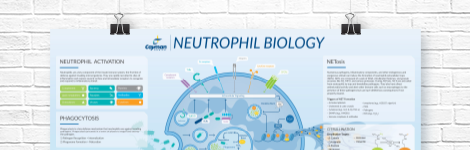
Neutrophil Biology Wall Poster
Explore how neutrophils shape the immune response in health and disease. This poster highlights neutrophil pathogen defense mechanisms, including phagocytosis, degranulation, and NETosis, as well as neutrophil roles in inflammation and NET-associated pathologies.
DOWNLOAD NOWProduct Description
Desipramine-d4 is intended for use as an internal standard for the quantification of desipramine by GC- or LC-MS. Desipramine is a tricyclic antidepressant and an active metabolite of imipramine (Item No. 15890).1 It inhibits the serotonin (5-HT) and norepinephrine transporters (Kis = 163 and 3.5 nM for human SERT and NET, respectively) and is an antagonist of the 5-HT receptor subtype 5-HT2A and the α1-adrenergic receptor (α1-AR), as well as histamine H1 and muscarinic acetylcholine receptors (mAChRs; Kis = 115, 23, 31, and 37 nM, respectively). Desipramine is selective for the 5-HT2A receptor over the 5-HT1A receptor (Ki = 2,272 nM) and for α1-AR over α2-AR (Ki = 1,379 nM). It also selectively inhibits G protein-activated inward rectifier potassium channel (GIRK), also known as Kir3, currents in Xenopus oocytes expressing human GIRK1 and GIRK2 or human GIRK1 and GIRK4 (IC50s = 36.4 and 53.9 µM, respectively) over Kir1.1 or Kir2.1 currents in Xenopus oocytes expressing the human channels (IC50s = >100 µM for both).2 Desipramine (3.2 mg/kg) decreases immobility time in the forced swim test in mice.3 It also decreases flinching, as well as paw biting and licking, in the second phase of the formalin test in rats.4 Formulations containing desipramine have been used in the treatment of depression.
WARNING This product is not for human or veterinary use.
References & Product Citations
1. Neurotransmitter receptor and transporter binding profile of antidepressants and their metabolites. J. Pharmacol. Exp. Ther. 283(3), 1305-1322 (1997).
2. Inhibition of G protein-
3. Effects of the antidepressants desipramine and fluvoxamine on latency to immobility and duration of immobility in the forced swim test in adult male C57BL/6J mice. Behav. Pharmacol. 29(5), 453-456 (2018).
4. Peripheral antinociceptive actions of desipramine and fluoxetine in an inflammatory and neuropathic pain test in the rat. Pain 82(2), 149-158 (1999).
Contact Info
Cayman Chemical1180 East Ellsworth RoadAnn Arbor, Michigan 48108 USAToll Free: (800) 364-9897(USA and Canada only)Fax: (734) 971-3640


