
Technical Support & Resources
Visit our FAQ
Contact Us
Toll Free Phone (USA and Canada Only): (888) 526-5351
Direct Phone: (734) 975-3888
Product Categories
Glypican-3 Rabbit Monoclonal Antibody (PE) (Clone 024)
Item No. 37008
Technical Information
- GPC3
- MXR7
- OCI-5
Shipping & Storage Information
Recommended Products
Certificates of Analysis & Batch Specific Data
Provide batch numbers separated by commas to download or request available product inserts, QC sheets, certificates of analysis, data packs, and GC-MS data.

Visit Our Cancer Resource Center
Find Tools & Resources to Study the Hallmarks of Cancer
- Cancer cell signaling & regulation
- Cancer metabolism
- Tumor microenvironment
Product Description
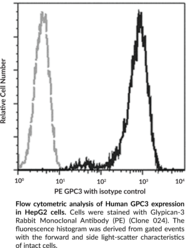
Glypican-3 (GPC3) is a membrane-bound heparan sulfate proteoglycan.1 It is composed of a signal peptide for membrane translocation, a cysteine-rich domain that contains a proteolytic cleavage site for proprotein convertases, a stalk region that contains heparan sulfate attachment sites, and a signal sequence for glycosylphosphatidylinositol (GPI) attachment, which anchors it to the cell surface. GPC3 is ubiquitously expressed during embryonic development and is only expressed in select adult tissues, including gastric glands and kidney tubules.2,3 It is involved in canonical and non-canonical Wnt signaling and binds to various Wnt ligands and Frizzled receptors.1,4 GPC3-targeting antibodies induce antibody-dependent cellular cytotoxicity (ADCC) and reduce tumor growth in hepatocellular carcinoma (HCC) mouse xenograft models.5 Hepatic levels of GPC3 are increased in patients with HCC.6 Mutations in GPC3 are associated with Simpson-Golabi-Behmel syndrome (SGBS), an X-linked condition characterized by pre- and post-natal overgrowth.2 Cayman’s Glypican-3 Rabbit Monoclonal Antibody (PE) (Clone 024) is composed of a GPC3 monoclonal antibody conjugated to phycoerythrin (PE) and can be used for flow cytometry (FC).
WARNING This product is not for human or veterinary use.
References & Product Citations
1. Processing by proprotein convertases is required for glypican-
2. Mutations in GPC3, a glypican gene, cause the Simpson-
3. Glypican 3 expression in human nonneoplastic, preneoplastic, and neoplastic tissues: A tissue microarray analysis of 4,387 tissue samples. Am. J. Clin. Pathol. 129(6), 899-906 (2008).
4. Glypican-
5. Anti-
6. Glypican-
Contact Info
Cayman Chemical1180 East Ellsworth RoadAnn Arbor, Michigan 48108 USAToll Free: (800) 364-9897(USA and Canada only)Fax: (734) 971-3640


