
Technical Support & Resources
Visit our FAQ
Contact Us
Toll Free Phone (USA and Canada Only): (888) 526-5351
Direct Phone: (734) 975-3888
Product Categories
p53 (cynomolgus monkey) Monoclonal Antibody (Clone 06)
Item No. 37069
Technical Information
- Antigen NY-CO-13
- Cellular Tumor Antigen p53
- Phosphoprotein p53
- Transformation-related Protein 53
- Tumor Protein p53
- Tumor Suppressor p53
Shipping & Storage Information
Recommended Products
Certificates of Analysis & Batch Specific Data
Provide batch numbers separated by commas to download or request available product inserts, QC sheets, certificates of analysis, data packs, and GC-MS data.

Visit Our Cancer Resource Center
Find Tools & Resources to Study the Hallmarks of Cancer
- Cancer cell signaling & regulation
- Cancer metabolism
- Tumor microenvironment
Product Description
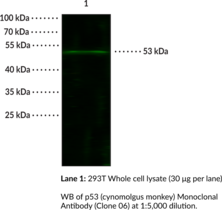
p53 is a transcription factor and tumor suppressor encoded by TP53 in humans with roles in cell cycle arrest, apoptosis, senescence, differentiation, and DNA repair.1,2 It is composed of two N-terminal intrinsically disordered transactivation domains (TADs), a proline-rich domain (PRD), a DNA-binding domain (DBD), a tetramerization domain (TD), and an intrinsically disordered C-terminal domain.1 p53 is ubiquitously expressed, with protein levels increasing under conditions of extra- or intracellular stress, such as DNA damage, oncogene activation, oxidative stress, or hypoxia.3 It is activated and translocated to the nucleus in response to cellular stress via post-translational modifications, such as phosphorylation, methylation, and acetylation, where it binds p53 consensus DNA-binding elements and regulates transcription of its target genes in a cell-, tissue-, and stress signal type-specific manner.1,3 Loss-of-function and/or gain-of-function mutations in TP53 occur in approximately 50% of human cancers.2 Cayman’s p53 (cynomolgus monkey) Monoclonal Antibody (Clone 06) can be used for ELISA and Western blot (WB) applications.
WARNING This product is not for human or veterinary use.
References & Product Citations
1. p53 Modifications: Exquisite decorations of the powerful guardian. J. Mol. Cell Biol. 11(7), 564-577 (2019).
2. Gain-
3. Mutant p53 in cancer: Accumulation, gain-
Contact Info
Cayman Chemical1180 East Ellsworth RoadAnn Arbor, Michigan 48108 USAToll Free: (800) 364-9897(USA and Canada only)Fax: (734) 971-3640


