
Technical Support & Resources
Visit our FAQ
Contact Us
Toll Free Phone (USA and Canada Only): (888) 526-5351
Direct Phone: (734) 975-3888
Technical Information
- Fatty Acid-binding Protein 6
- I-BALB
- Ileal Lipid-binding Protein
- ILLBP
- Intestinal Bile Acid-binding Protein
Shipping & Storage Information
Recommended Products
Certificates of Analysis & Batch Specific Data
Provide batch numbers separated by commas to download or request available product inserts, QC sheets, certificates of analysis, data packs, and GC-MS data.

Explore Obesity & Metabolic Disease Resources
Discover high-quality research tools to investigate GLP-1 mechanisms and next-generation metabolic targets.
OBESITY RESEARCH SOLUTIONSProduct Description
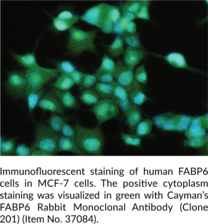
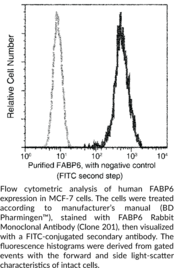
Fatty acid-binding protein 6 (FABP6) is a member of the intracellular lipid-binding protein (iLBP) family with a role in bile acid homeostasis.1,2 It is composed of 10 antiparallel β-strands, which form a β-barrel containing a lipid binding site and is expressed primarily in enterocytes of the ileum, and to a lesser extent in the adrenal gland, ovaries, and stomach.3,4,1 FABP6 binds bile acids and fatty acids and interacts with the ileal bile acid transporter to aid in bile acid uptake and facilitate intracellular trafficking of bile acids.1 Fabp6 knockdown induces dietary fat malabsorption, decreased bile acid reabsorption, and a sex-specific increase in adiposity in mice fed a Western diet.5 Serum levels of FABP6 are increased in patients with colorectal cancer and decrease following surgical removal of cancerous tissues.6 FABP6T79M is associated with a decreased risk of type 2 diabetes in obese individuals.7 Cayman’s FABP6 Rabbit Monoclonal Antibody (Clone 201) can be used for flow cytometry (FC), immunocytochemistry (ICC), and immunofluorescence (IF) applications.
WARNING This product is not for human or veterinary use.
References & Product Citations
1. The human fatty acid-
2. Identification and investigation of novel binding fragments in the fatty acid binding protein 6 (FABP6). J. Med. Chem. 59(17), 8094-8102 (2016).
3. Structural and functional analysis of fatty acid-
4. Intestinal fatty acid-
5. Sexually dimorphic response of mice to the Western-
6. High expression of FABP4 and FABP6 in patients with colorectal cancer. World J. Surg. Oncol. 17(1), 171 (2019).
7. Evidence for the Thr79Met polymorphism of the ileal fatty acid binding protein (FABP6) to be associated with type 2 diabetes in obese individuals. Mol. Genet. Metab. 98(4), 400-405 (2009).
Contact Info
Cayman Chemical1180 East Ellsworth RoadAnn Arbor, Michigan 48108 USAToll Free: (800) 364-9897(USA and Canada only)Fax: (734) 971-3640


