
Technical Support & Resources
Visit our FAQ
Contact Us
Toll Free Phone (USA and Canada Only): (888) 526-5351
Direct Phone: (734) 975-3888
Product Categories
Application

Technical Information
- Cluster of Differentiation 25
- IL-2Rα
- Interleukin-2 Receptor Subunit α
- TAC Antigen
Shipping & Storage Information
Recommended Products
Certificates of Analysis & Batch Specific Data
Provide batch numbers separated by commas to download or request available product inserts, QC sheets, certificates of analysis, data packs, and GC-MS data.

Visit Our Cancer Resource Center
Find Tools & Resources to Study the Hallmarks of Cancer
- Cancer cell signaling & regulation
- Cancer metabolism
- Tumor microenvironment
Product Description
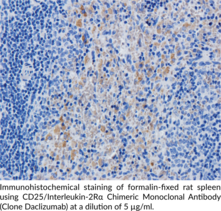
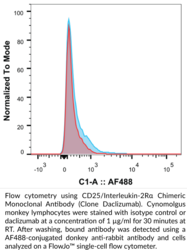
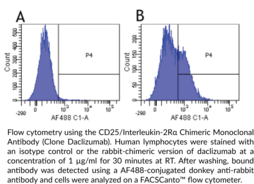
CD25, also known as interleukin-2 receptor α (IL-2Rα), is a transmembrane glycoprotein.1 It is composed of two domains, D1 and D2, and associates with the CD122/IL-2β and CD132/IL-2γc subunits to form the heterotrimeric IL-2 receptor. CD25 is expressed in activated T and B cells, regulatory T cells, and lymphokine-activated killer (LAK) cells.2,3,4 Activation of IL-2R on T cells increases the expression of CD25 and leads to T cell proliferation and differentiation, as well as activation-induced T cell death.3,4 ILR2A expression and CD25 protein levels in bone marrow are increased in patients with acute myeloid leukemia (AML) and associated with poor prognosis.3 SNPs in ILR2A and elevated serum levels of a soluble form of CD25 are associated with an increased risk of Graves' disease.5 Cayman's CD25/Interleukin-2Rα Chimeric Monoclonal Antibody (Clone Daclizumab) was produced recombinantly from the original humanized antibody and can be used for flow cytometry (FC). The original antibody was generated by fusing human framework and constant domains to the antigen-binding domain of a mouse anti-CD25/IL2Rα monoclonal antibody, which targets the ERIYHV peptide corresponding to amino acids 116 to 122 of human CD25.6,7
WARNING This product is not for human or veterinary use.
References & Product Citations
1. Crystal structure of the IL-
2. IL-
3. Role of CD25 expression on prognosis of acute myeloid leukemia: A literature review and meta-
4. The IL-
5. Immunogenetics of autoimmune thyroid diseases: A comprehensive review. J. Autoimmun. 64, 82-90 (2015).
6. A humanized antibody that binds to the interleukin 2 receptor. Proc. Natl. Acad. Sci. USA. 86(24), 10029-10033 (1989).
7. Identification of their epitope reveals the structural basis for the mechanism of action of the immunosuppressive antibodies basiliximab and daclizumab. Cancer Res. 67(8), 3518-3523 (2007).
Contact Info
Cayman Chemical1180 East Ellsworth RoadAnn Arbor, Michigan 48108 USAToll Free: (800) 364-9897(USA and Canada only)Fax: (734) 971-3640


