
Technical Support & Resources
Visit our FAQ
Contact Us
Toll Free Phone (USA and Canada Only): (888) 526-5351
Direct Phone: (734) 975-3888
Product Categories
Application
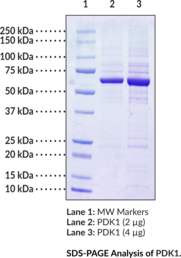

Technical Information
- 3-Phosphoinositide-dependent Protein Kinase 1
Shipping & Storage Information
Recommended Products
Certificates of Analysis & Batch Specific Data
Provide batch numbers separated by commas to download or request available product inserts, QC sheets, certificates of analysis, data packs, and GC-MS data.
Kinase Resource Center
Discover Products & Resources for Kinase Research
- Kinase inhibitors, screening libraries, assay kits, & more
- Tools to study kinase signaling pathways:
- Growth factor signaling
- PI3K/Akt/mTOR
- MAPKs (ERK, p38, & JNK)
- JAK/STAT signaling
- Articles, resources, & advice
Product Description
3-Phosphoinositide-dependent protein kinase 1 (PDK1) is a serine/threonine kinase with roles in cell survival, differentiation, and proliferation, metabolic regulation, and immune development.1,2,3 It is composed of an N-terminal bilobular kinase domain, with the small lobe housing a PIF-pocket/αC-helix region and the large lobe containing an activation loop, and a C-terminal PH domain.1 PDK1 is activated by autophosphorylation of serine 241 in the activation loop, a residue that is poorly accessible to phosphatases, and is considered constitutively active.1 It phosphorylates and activates various members of the AGC protein kinase family, including Akt, p70 ribosomal S6 kinase (p70S6K), serum/glucocorticoid regulated kinase (SGK), and PKC to regulate the PI3K/Akt, Ras/MAPK, and Myc signaling pathways.1,2 Gene amplification of PDPK1, the gene encoding PDK1, is associated with poor prognosis in patients with breast cancer and metastasis in patients with prostate cancer.1 Knockdown of Pdpk1 promotes axon regeneration in a mouse model of sciatic nerve injury and inhibits T follicular helper (Tfh) cell differentiation and germinal center responses in a mouse model of acute lymphocytic choriomeningitis virus (LCMV) infection.2,3
WARNING This product is not for human or veterinary use.
References & Product Citations
1. PDK1: At the crossroad of cancer signaling pathways. Semin. Cancer Biol. 48, 27-35 (2018).
2. PDK1 is a negative regulator of axon regeneration. Mol. Brain 14(1), 31 (2021).
3. The kinase PDK1 is critical for promoting T follicular helper cell differentiation. Elife 10, e61406 (2021).
Contact Info
Cayman Chemical1180 East Ellsworth RoadAnn Arbor, Michigan 48108 USAToll Free: (800) 364-9897(USA and Canada only)Fax: (734) 971-3640


