
Technical Support & Resources
Visit our FAQ
Contact Us
Toll Free Phone (USA and Canada Only): (888) 526-5351
Direct Phone: (734) 975-3888
Technical Information
- Xanthine Dehydrogenase/Oxidase
- Xanthine Oxidoreductase
- XO
- XOR
Shipping & Storage Information
Recommended Products
Certificates of Analysis & Batch Specific Data
Provide batch numbers separated by commas to download or request available product inserts, QC sheets, certificates of analysis, data packs, and GC-MS data.

Explore Obesity & Metabolic Disease Resources
Discover high-quality research tools to investigate GLP-1 mechanisms and next-generation metabolic targets.
OBESITY RESEARCH SOLUTIONSProduct Description
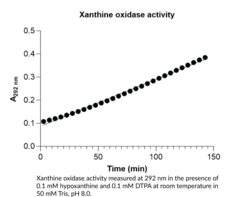
Xanthine oxidase (XO) is a complex metalloflavoprotein involved in purine catabolism, oxidative stress, and xenobiotic metabolism, among other processes.1,2 It exists as a homodimer and each monomer is composed of an N-terminal domain that contains two unequal iron-sulfur clusters, an intermediate domain that contains the FAD cofactor, and a C-terminal domain that contains the molybdopterin cofactor. XO is primarily expressed in the liver and intestines, has been found in blood, serum, and milk, and localizes to the cytosol, cell membrane, and peroxisomes.1 It is produced by irreversible or reversible post-translational modification of xanthine dehydrogenase (XD) via limited proteolysis or oxidation of XD thiol groups, respectively.1,2 XO catalyzes the conversion of hypoxanthine to xanthine to uric acid and uses molecular oxygen as the electron acceptor, compared with XD that uses NAD+, and this results in the generation of hydrogen peroxide and superoxide, which can react with nitric oxide (NO) to produce peroxynitrite.1,2,3 In hypoxic conditions, XO converts nitrates and nitrite to NO.4 Increased blood levels of XO’s enzymatic product uric acid, hyperuricemia, is associated with several diseases, including gout, cardiovascular disease, ischemia-reperfusion injury, obesity, and diabetes.1,2,5,6,7 XO has commonly been used in coupled enzyme assays to measure superoxide dismutase (SOD) activity.8,9 Cayman’s Xanthine Oxidase (bovine) protein can be used for enzyme activity assays.
WARNING This product is not for human or veterinary use.
References & Product Citations
1. Pathophysiology of circulating xanthine oxidoreductase: New emerging roles for a multi-
2. Pro-
3. Regulation of xanthine oxidase by nitric oxide and peroxynitrite. The Journal of Biological Chemisty 275(13), 9369-9376 (2000).
4. Xanthine oxidoreductase catalyses the reduction of nitrates and nitrite to nitric oxide under hypoxic conditions. FEBS Lett. 427, 225-228 (1998).
5. Emerging role of purine metabolizing enzymes in brain function and tumors. Int. J. Mol. Sci. 19(11), 3598 (2018).
6. Uric acid and xanthine oxidase: Future therapeutic targets in the prevention of cardiovascular disease? Br. J. Clin. Pharmac. 62(6), 633-644 (2006).
7. Uric acid and oxidative stress. Curr. Pharm. Des. 11(32), 4145-4151 (2005).
8. A simple method for clinical assay of superoxide dismutase. Clin. Chem. 34(3), 497-500 (1988).
9. Subcellular distribution of superoxide dismutases (SOD) in rat liver: Cu, Zn-
Contact Info
Cayman Chemical1180 East Ellsworth RoadAnn Arbor, Michigan 48108 USAToll Free: (800) 364-9897(USA and Canada only)Fax: (734) 971-3640


