
Technical Support & Resources
Visit our FAQ
Contact Us
Toll Free Phone (USA and Canada Only): (888) 526-5351
Direct Phone: (734) 975-3888
Product Categories
Product Type
Research Area
Technical Information
- Advanced Glycosylation End Product-specific Receptor
- AGER
- Receptor for Advanced Glycosylation End Products
Shipping & Storage Information
Recommended Products
Certificates of Analysis & Batch Specific Data
Provide batch numbers separated by commas to download or request available product inserts, QC sheets, certificates of analysis, data packs, and GC-MS data.

Explore Obesity & Metabolic Disease Resources
Discover high-quality research tools to investigate GLP-1 mechanisms and next-generation metabolic targets.
OBESITY RESEARCH SOLUTIONSProduct Description
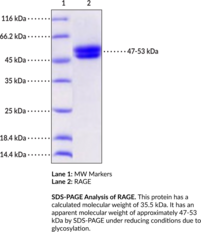
Receptor for advanced glycation end products (RAGE) is a transmembrane protein and member of the IgG superfamily.1 It is composed of one V-type domain that is responsible for extracellular ligand binding, two C-type domains, a transmembrane domain, and a cytosolic tail involved in intracellular signaling. In addition to full-length and membrane-bound forms, soluble forms of RAGE can be formed either by proteolytic cleavage or alternative splicing. It is highly expressed in the mature lung pneumocytes and embryonic cells and is expressed at lower levels in many other cell types. RAGE has a variety of ligands that share a common structural motif, including AGEs, high mobility group box 1 (HMGB1), certain S100 proteins, and amyloid-β peptide fibrils.2 Ligand activation of RAGE induces binding of the cytoplasmic tail to bridge proteins, such as diaphanous-related formin 1 (DIAPH1) and myeloid differentiation factor 88 adapter-like protein (Mal), which then activate MEK/ERK, PI3K/Akt, and JAK/STAT signaling pathways, among others, and lead to activation of NF-κB. RAGE levels increase rapidly at sites of inflammation, and full-length RAGE is associated with a pro-inflammatory state.1,2 Protein levels of RAGE are increased in postmortem coronary atherosclerotic lesions from patients with diabetes who died from sudden cardiovascular complications.3,4 However, plasma levels of soluble RAGE are lower in non-diabetic men with coronary artery disease (CAD) than those without CAD.5,4 Levels of full-length RAGE are decreased in non-small cell lung carcinoma (NSCLC) tissue compared with non-cancerous lung tissue, and proliferation of lung cancer cells overexpressing RAGE is reduced in vitro.6 Cayman’s RAGE (human, recombinant) protein can be used for binding assays. This protein consists of 332 amino acids, has a calculated molecular weight of 35.5 kDa, and a predicted N-terminus of Ala23 after signal peptide cleavage. By SDS-PAGE, under reducing conditions, the apparent molecular mass of the protein is 47-53 kDa due to glycosylation.
WARNING This product is not for human or veterinary use.
References & Product Citations
1. RAGE (receptor for advanced glycation endproducts), RAGE ligands, and their role in cancer and inflammation. J. Transl. Med. 7, 17 (2009).
2. Pathophysiology of RAGE in inflammatory diseases. Front. Immunol. 13, 931743 (2022).
3. Morphologic findings of coronary atherosclerotic plaques in diabetics: A postmortem study. Arterioscler. Thromb. Vasc. Biol. 24(7), 1266-1271 (2004).
4. Receptor for AGE (RAGE) and its ligands -
5. Plasma levels of soluble receptor for advanced glycation end products and coronary artery disease in nondiabetic men. Arterioscler. Thromb. Vasc. Biol. 25(5), 1032-1037 (2005).
6. Down-
Contact Info
Cayman Chemical1180 East Ellsworth RoadAnn Arbor, Michigan 48108 USAToll Free: (800) 364-9897(USA and Canada only)Fax: (734) 971-3640


